Published · Updated · CERAMIC CNC Engineering · Engineering Guide · 14 min read
Aluminum Nitride Ceramic Machining for Thermal Management Components
How engineers should specify aluminum nitride ceramic machining for heat spreaders, insulating plates, substrates, spacers, carriers, power electronics fixtures, and thermal-interface components.
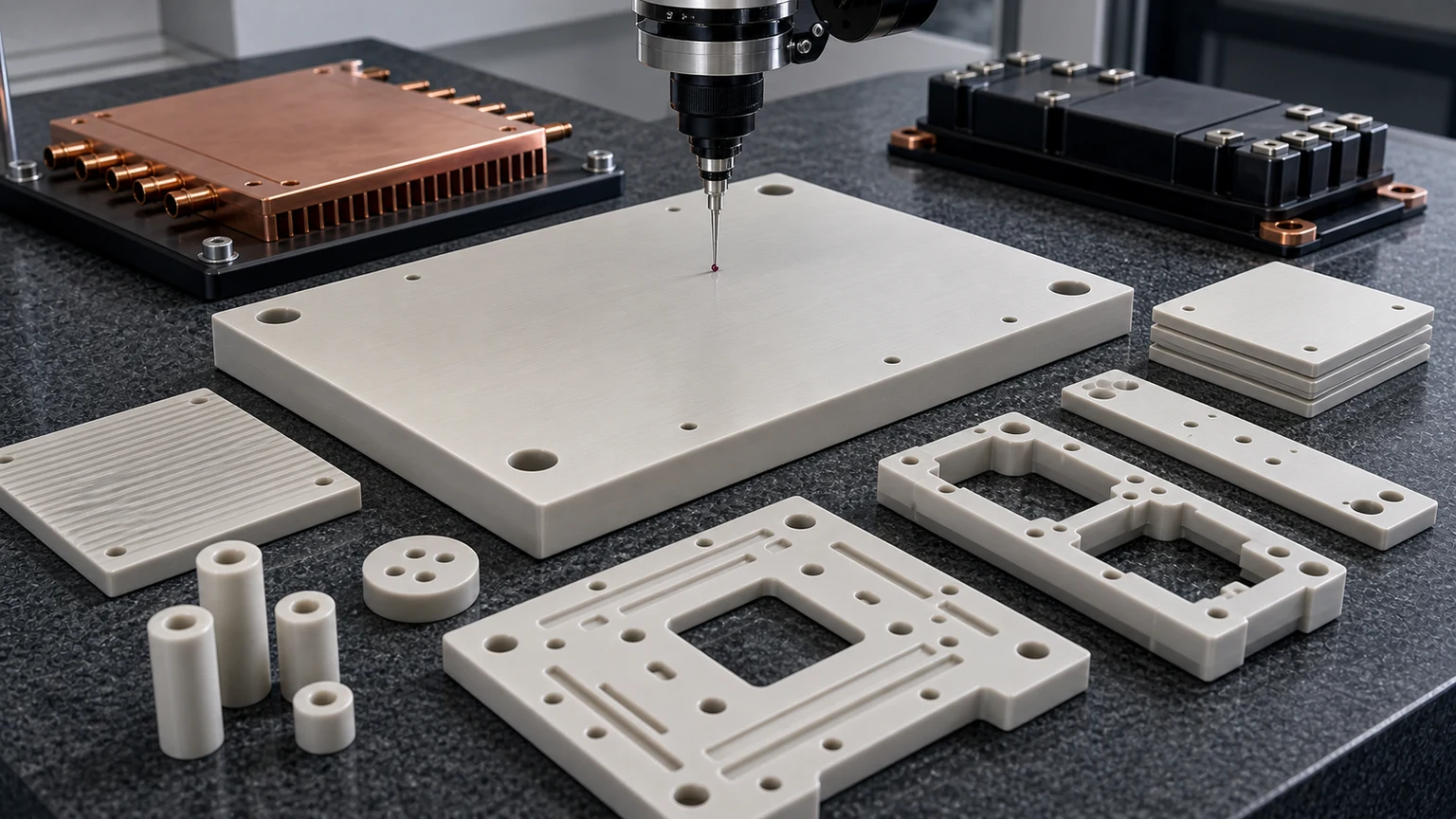
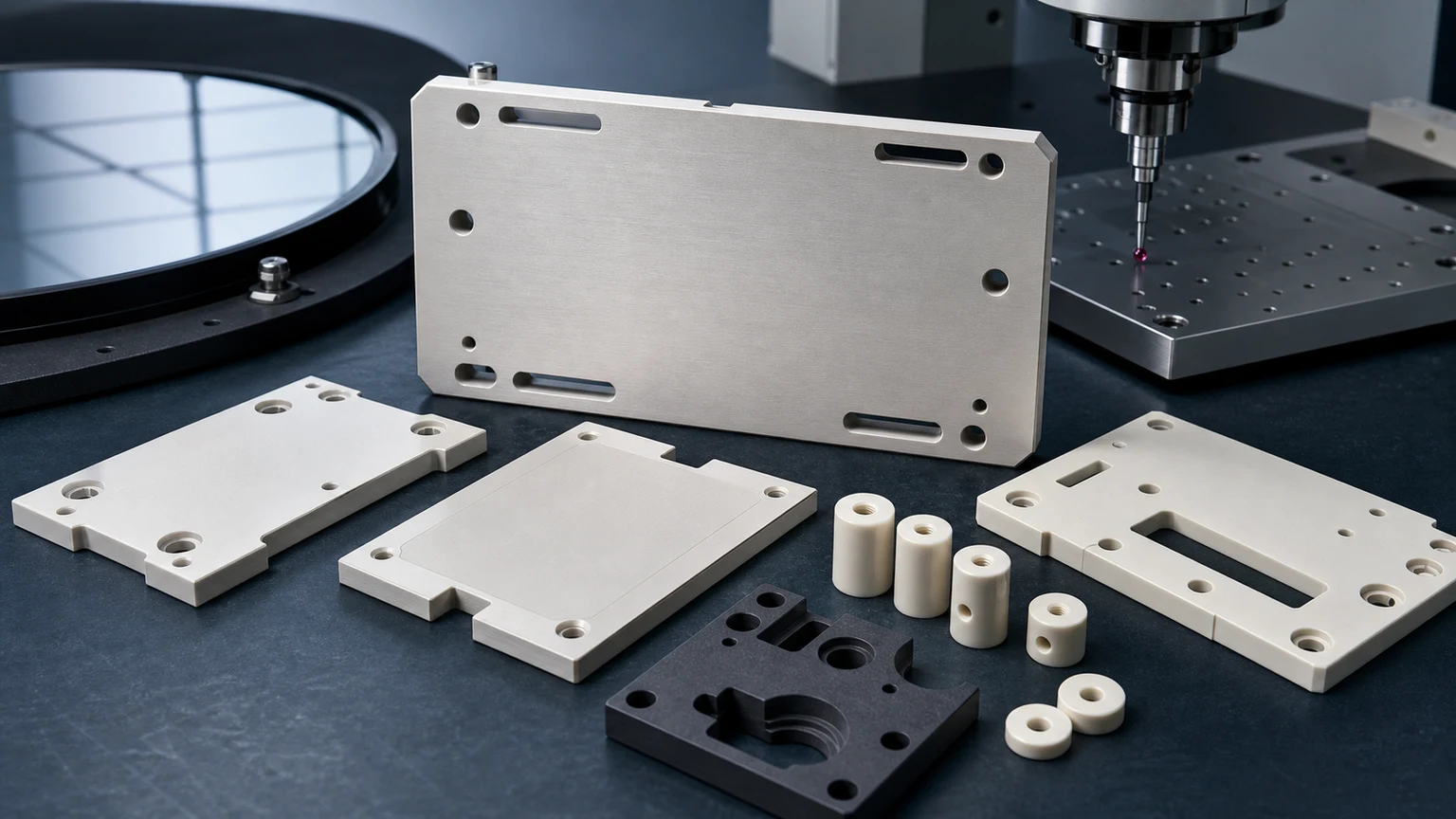
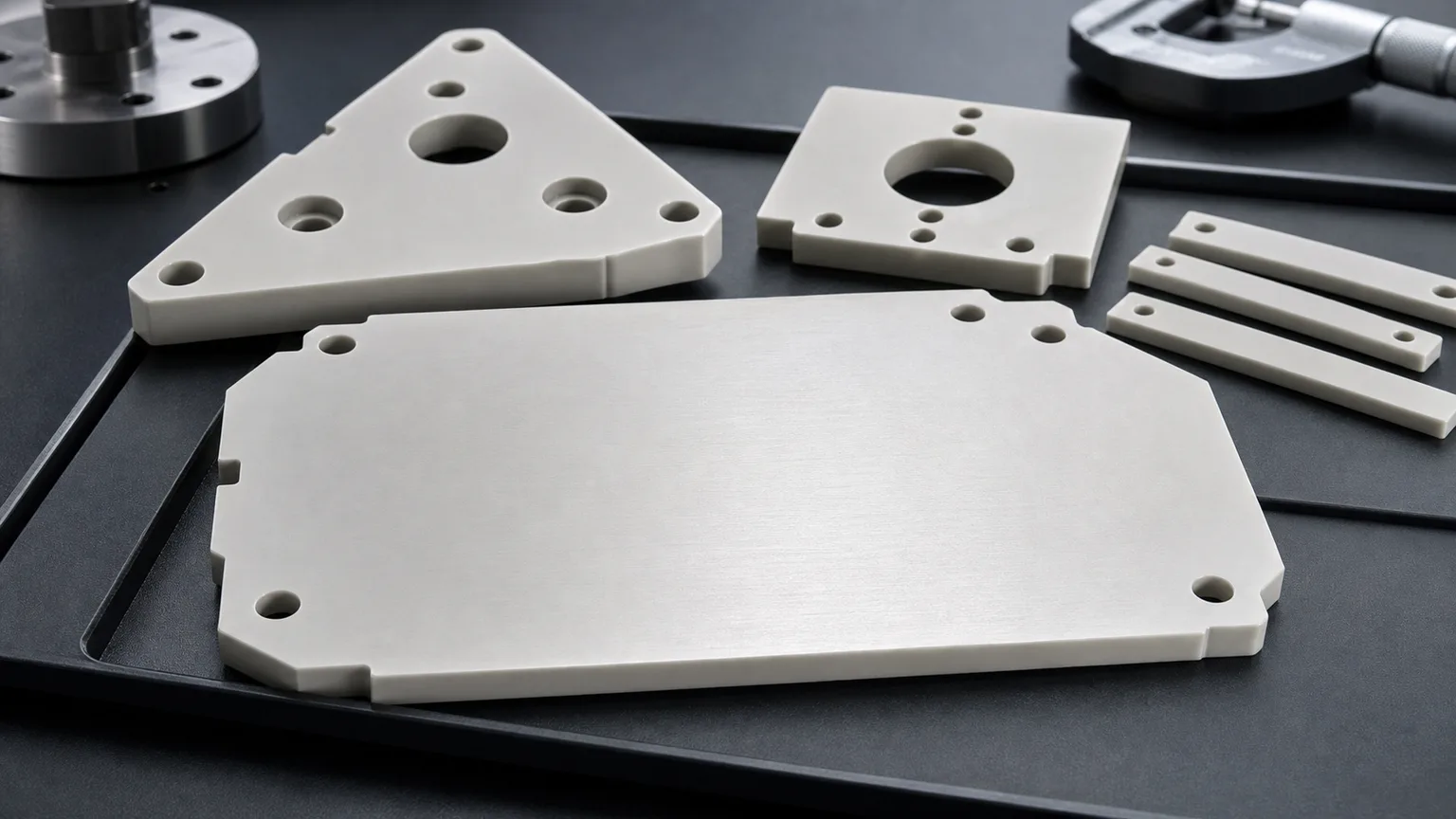
Aluminum nitride ceramic machining is usually considered when a component must combine thermal management with electrical insulation, dimensional stability, and clean ceramic surfaces. AlN can be valuable in power electronics, semiconductor equipment, test fixtures, and thermal-interface hardware, but the final part depends on grade, blank condition, flatness, thickness control, surface finish, edge quality, and inspection evidence.
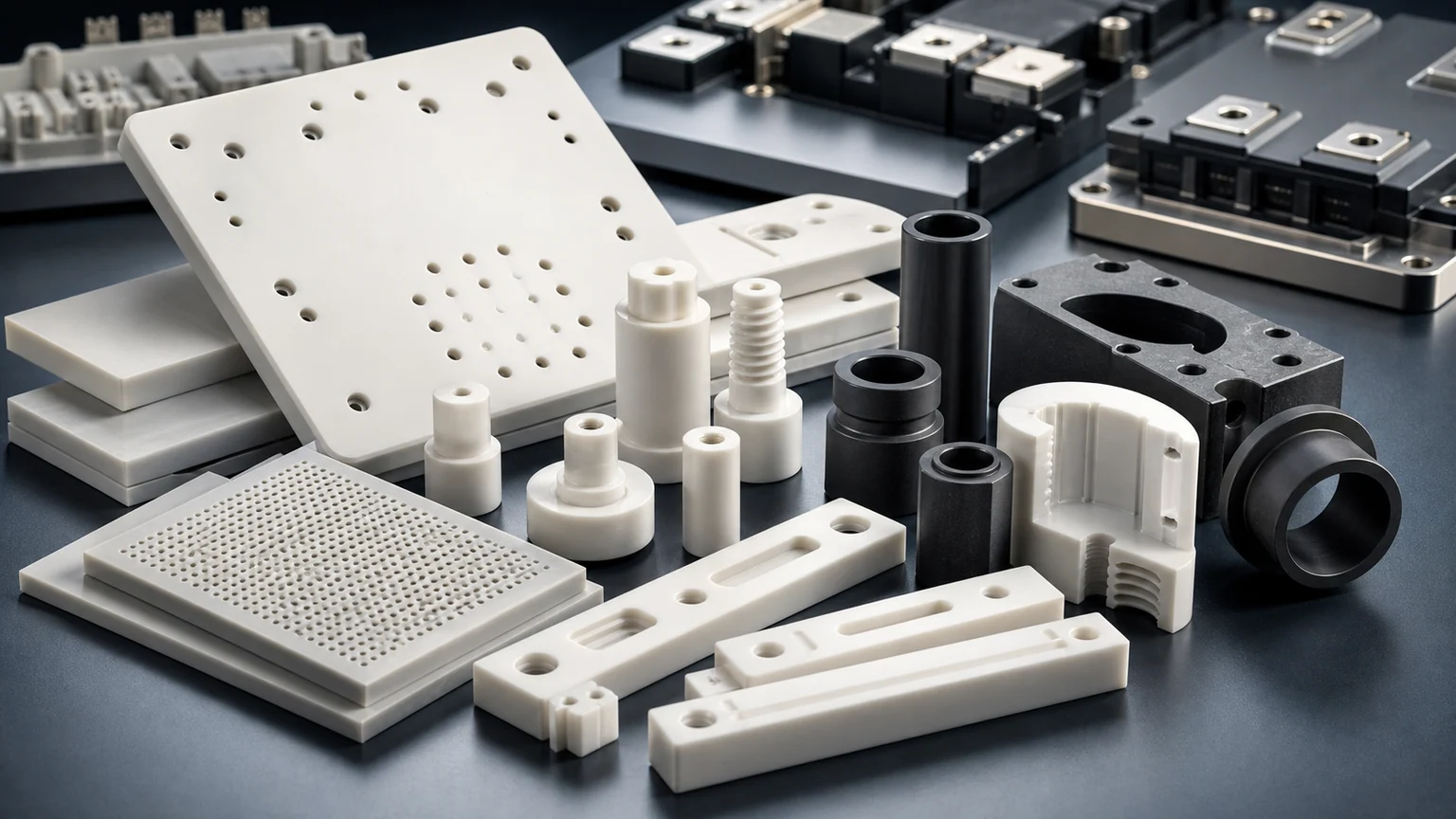
Aluminum nitride ceramic parts appear in power electronics assemblies, semiconductor thermal management, high-voltage test fixtures, RF and microwave hardware, laser and optical equipment, sensor assemblies, vacuum systems, and custom industrial devices where heat must be moved while electrical isolation is maintained. Typical RFQs include AlN heat spreaders, insulating plates, substrates, carriers, spacers, standoffs, pressure pads, fixture plates, thermal interface blocks, sensor mounts, and custom machined ceramic components. When an AlN plate is controlled by dielectric spacing, metallization, or a high-frequency assembly, use the RF and microwave ceramic plate RFQ guide to separate electrical-design ownership from machining acceptance.
The practical sourcing question is not simply “Can aluminum nitride be machined?”
The better question is:
Which AlN grade, thermal-interface surface, flatness target, thickness tolerance, edge condition, cleaning requirement, and inspection method are required for this part to work in the assembly?
That question should be reviewed before feasibility, price, lead time, or production route is confirmed.
Why Aluminum Nitride Is Used For Thermal Management
Aluminum nitride, often written as AlN, is selected because it can offer a useful combination of thermal conductivity and electrical insulation. That combination makes it attractive where a metal heat spreader would create an electrical path, where a polymer insulator cannot handle the thermal load, or where alumina does not provide enough thermal performance for the design.
AlN is not selected only because it is “high thermal conductivity.” The part still has to be machined, handled, cleaned, assembled, and inspected as a brittle technical ceramic. A flat heat spreader with a few holes can be straightforward, but the risk changes when the drawing includes thin sections, tight flatness, closely spaced holes, pockets, sharp corners, fine surface finish, or contamination-sensitive surfaces.
Aluminum nitride is most useful when the design takes advantage of these strengths:
- Thermal spreader plates that need electrical isolation.
- Ceramic substrates and carriers near power devices.
- Insulating thermal pads or pressure plates in test fixtures.
- Semiconductor equipment components where heat, cleanliness, and stability matter together.
- High-voltage support parts with improved heat transfer versus standard insulation ceramics.
- Sensor, laser, RF, or optical mounts where thermal stability affects performance.
- Custom fixtures that need flat ceramic contact surfaces and repeatable dimensions.
The broader ceramic material selection guide can help compare aluminum nitride with alumina, zirconia, silicon nitride, silicon carbide, MACOR, and boron nitride.
Aluminum Nitride Compared With Other Engineering Ceramics
AlN is often compared with alumina because both are electrical insulation ceramics. It is also reviewed alongside silicon nitride and silicon carbide when the part must survive mechanical or thermal stress. The right choice depends on the failure mode, not on a single material property.
| Material | Where it is often considered | RFQ review focus |
|---|---|---|
| Aluminum nitride AlN | Thermal management with electrical insulation | Flatness, thickness, thermal-interface surface, cleaning, and assembly method |
| Alumina Al2O3 | Electrical insulation, general wear, fixtures, spacers | Purity, cost target, insulation path, edge quality, and functional surfaces |
| Silicon nitride Si3N4 | Structural wear parts, thermal shock, rollers, shafts, guides | Load path, shock, roundness, finish, and grade |
| Silicon carbide SiC | Harsh chemical wear, seal faces, process-side components | Grade, lapped surfaces, media, edge quality, and inspection evidence |
| Zirconia ZrO2 | High-strength pins, plungers, sleeves, precision mechanisms | Toughness, edge risk, sliding fit, surface finish, and assembly stress |
| MACOR glass ceramic | Fast prototype or lab insulation parts | Service limit, prototype intent, and transition to final production material |
| Boron nitride BN | High-temperature insulation and release-contact parts | Grade, atmosphere, low strength limits, and contact load |
For low-cost electrical insulation, precision machined alumina ceramic parts may be sufficient. For structural wear or thermal shock, silicon nitride ceramic machining may deserve review. For harsh chemical process-side hardware, silicon carbide ceramic machining may fit better. AlN becomes especially valuable when thermal transfer and electrical isolation must be solved together.
Common Aluminum Nitride Machined Parts
Most AlN machining projects become clearer when the part is described by thermal and electrical function rather than by shape alone.
| Part type | Common function | Critical review points |
|---|---|---|
| Heat spreaders and thermal plates | Move heat while maintaining electrical insulation | Flatness, thickness, contact surface finish, hole location, and cleaning |
| Insulating substrates and carriers | Support power, RF, laser, or sensor hardware | Surface quality, edge chips, thickness tolerance, metallization or bonding condition |
| Pressure pads and fixture plates | Distribute clamp load in test or assembly equipment | Parallelism, flatness, edge break, load path, and contact area |
| Spacers, standoffs, and isolation pads | Provide spacing and insulation near heat-generating devices | Height tolerance, parallelism, bore quality, chamfer, and assembly method |
| Thermal-interface blocks | Transfer heat between device, fixture, or cooling hardware | Mating surface, flatness, Ra, thickness, and interface material |
| Semiconductor thermal components | Clean, stable support around high-temperature process areas | Cleanliness, particle-sensitive edges, flatness, pockets, grooves, and holes |
| RF, laser, and sensor mounts | Stable ceramic support with controlled thermal behavior | Datum faces, surface finish, flatness, bore position, and assembly stress |
A simple AlN plate, a thin insulating substrate, a lapped thermal pad, and a pocketed fixture frame should not be quoted as if they carry the same machining risk. The thermal-interface surfaces and inspection requirements usually decide the route.
Grade, Blank Condition, And Handling Must Be Defined
“Aluminum nitride” is not a complete material specification. AlN grades can vary in thermal behavior, density, purity, color, surface condition, grain structure, additive system, and response to machining or cleaning. Some projects require a customer-specified grade. Others start from the operating environment and then review an appropriate material option.
The RFQ should clarify whether the project needs:
- A specific AlN grade listed on the drawing or approved vendor list.
- A general thermal-management AlN material for a custom machined part.
- A high-purity or semiconductor-adjacent material control.
- A prototype material for fixture or assembly evaluation.
- A production grade with certificate, lot traceability, or incoming inspection documentation.
- A material that may later be metallized, bonded, brazed, coated, or assembled with thermal interface material.
Blank condition also matters. Some AlN parts can start from plate, sheet, rod, or near-net blanks, while precision features are finished after firing. Fired AlN is hard and brittle, so critical features are usually produced by diamond grinding, abrasive machining, drilling, lapping, polishing, or related finishing steps. The more material removed after firing, the more the route depends on geometry and inspection.
Handling should be included in the review. AlN parts may have thin edges, polished or lapped surfaces, and surfaces that must remain clean for bonding or thermal contact. Packaging, cleaning, and non-contact handling can matter as much as the nominal dimension when the part is used in a precision assembly.
Machining Route For AlN Thermal Components
AlN machining is usually planned around functional surfaces. The most expensive part of a drawing may not be the outside profile; it may be a flat thermal contact face, a thin plate that must remain stable, or a small hole pattern close to an edge.
A typical review may consider:
- Near-net blank selection to reduce unnecessary grinding.
- Surface grinding for flatness and thickness control.
- Lapping or polishing where a thermal-interface surface requires controlled contact.
- Diamond drilling or abrasive machining for holes and pockets.
- Controlled chamfers to reduce edge chips during assembly.
- Datum creation before precision bores, slots, or mounting holes.
- Cleaning and packaging after final inspection.
The ceramic CNC machining design rules are useful for AlN because many RFQs arrive with metal-style features. Sharp internal corners, deep narrow pockets, thin unsupported tabs, hole patterns too close to edges, and blanket tight tolerances can make an otherwise reasonable thermal component difficult or expensive.
Flatness, Thickness, And Thermal Contact
Thermal management parts often fail because the interface is not controlled, not because the base material is wrong. A heat spreader with high theoretical thermal conductivity still performs poorly if it contacts the mating surface only at high spots or if assembly pressure creates local stress.
For AlN heat spreaders, thermal plates, and pressure pads, the drawing should define:
- Which face is the primary thermal-interface surface.
- Whether flatness applies to the full face or selected contact zones.
- Thickness tolerance and whether parallelism is required.
- Surface finish on the thermal contact face.
- Allowed chamfer or edge break.
- Hole and slot position relative to datum faces.
- Contact pressure, clamp method, or assembly stack if known.
- Thermal interface material, grease, pad, metallization, or bonding method if used.
The ceramic tolerance capability map can help decide where tight flatness, thickness, or hole-position requirements belong. A tight tolerance on every face can raise cost without improving heat transfer.
Surface Finish And Subsurface Damage
Surface finish in AlN should be connected to the function of the face. A thermal-interface face, bonding face, metallization surface, or optical-adjacent mount may need different control than a clearance edge or non-contact side wall.
For surface finish RFQs, specify:
- Which faces require ground, lapped, polished, or standard finish.
- Target Ra only where it affects thermal contact, bonding, sealing, or assembly.
- Whether the face will be metallized, bonded, coated, or used with thermal paste.
- Whether cosmetic scratches on non-functional faces are acceptable.
- Whether cleaning residue, particles, or edge chips are incoming inspection concerns.
The surface finish and subsurface damage guide explains why finish requirements should be face-specific. A fine Ra applied everywhere can turn a practical AlN component into an unnecessarily expensive machining project.
Holes, Pockets, Slots, And Thin Plates
AlN thermal components often include mounting holes, sensor holes, slots, pockets, reliefs, or cutouts. These features help the assembly, but they also introduce machining risk.
Useful drawing inputs include:
- Hole diameter, depth, and whether the hole is through or blind.
- Hole-to-edge distance and ligament width.
- Counterbore or countersink geometry if required.
- Slot width, length, and internal radius.
- Pocket depth and minimum corner radius.
- Plate thickness and unsupported area.
- Whether the hole or slot edge is a high-voltage creepage path.
- Whether the edge is functional, cosmetic, or non-critical.
Avoid sharp inside corners when possible. Use realistic radii and practical chamfers. For thin plates, give the supplier context about how the part is clamped, bonded, stacked, or handled. Thin ceramic plates may need a different blank route, support strategy, and inspection method than thick fixture blocks.
Aluminum Nitride In Power Electronics And Test Fixtures
Power electronics is one of the strongest application areas for machined AlN components. Buyers may need custom insulating thermal plates, device carriers, pressure pads, ceramic fixtures, sensor supports, and prototype thermal-interface parts around power modules, high-voltage systems, SiC or GaN devices, and dense power conversion hardware.
These RFQs should not be treated as generic ceramic plates. The review should include:
- Voltage class and insulation surfaces.
- Creepage or clearance intent if the ceramic geometry supports it.
- Maximum operating temperature and thermal cycling.
- Clamp force, pressure distribution, and contact area.
- Whether the AlN part touches copper, aluminum, module packaging, graphite, stainless steel, or thermal interface material.
- Whether the part is used in production hardware, test hardware, or development fixtures.
- Incoming inspection method for flatness, thickness, and edge quality.
The power electronics ceramic machining guide explains related RFQ concerns for high-voltage insulation, thermal interfaces, SiC module fixtures, and power hardware. For AlN specifically, thermal contact and electrical isolation should be reviewed together, not as separate requirements.
Aluminum Nitride In Semiconductor Thermal Management
AlN can also be reviewed for semiconductor equipment and clean manufacturing systems where thermal stability, electrical insulation, and cleanliness matter. Components may include thermal plates, ceramic carriers, sensor supports, precision spacers, heater-adjacent parts, vacuum-side fixtures, or chamber-adjacent hardware depending on the equipment.
For these projects, the RFQ should include:
- Process-side or fixture-side location.
- Temperature range and cycling.
- Vacuum, plasma, chemical, or cleaning exposure if relevant.
- Particle-sensitive edges and surfaces.
- Flatness and support surface requirements.
- Hole, groove, or pocket geometry.
- Cleaning, packaging, and traceability requirements.
- Whether metallization, bonding, or assembly is performed after machining.
The semiconductor equipment ceramic parts guide gives more context for process equipment ceramics. For a focused RFQ path around AlN heat spreaders, heater-adjacent plates, insulating thermal spacers, clean packaging, and semiconductor inspection evidence, use the AlN ceramic parts for semiconductor thermal management guide. When the AlN part is a heater-adjacent plate, thermal insulating spacer, electrode-adjacent component, or plasma etch/deposition insulator, the ceramic insulators for plasma etching and deposition equipment guide helps connect thermal-interface flatness with dielectric paths, cleaning, edge quality, and inspection evidence. In semiconductor-adjacent parts, the difference between a normal industrial edge and a particle-sensitive edge should be defined before production.
Cost Drivers In Aluminum Nitride Ceramic Machining
AlN machining cost is usually driven by surface control, thin geometry, hole complexity, and inspection rather than by outside size alone.
| Cost driver | Why it matters in AlN machining | How to control it in the RFQ |
|---|---|---|
| Tight flatness on large plates | Requires controlled grinding, lapping, handling, and repeated checks | Define the functional face and whether flatness is full-face or local |
| Tight thickness and parallelism | Adds grinding sequence control and inspection time | Apply to stack-critical or interface-critical zones only |
| Fine thermal-interface finish | Lapping or polishing may be needed on selected faces | Specify Ra and finish only where thermal contact, bonding, or sealing matters |
| Thin plates or unsupported cutouts | Increase breakage, warpage, and handling risk | Review thickness, support, blank route, and edge protection |
| Dense hole patterns | Hole quality, edge breakout, and position control add risk | Define functional holes, edge distance, and inspection method |
| Pockets and sharp internal corners | Tool access and chipping can dominate cost | Use larger radii and mark non-critical features |
| Cleanroom or bonding requirements | Cleaning, packaging, and surface protection add process control | State cleaning, packaging, and surface-contact restrictions |
| Metallization or downstream bonding | Machined surface condition affects later process yield | Share downstream process notes before final machining review |
The goal is not to remove precision from the drawing. The goal is to place precision where it supports heat transfer, insulation, assembly, and inspection.
Inspection Evidence For AlN Components
Inspection should match the functional risk. A heat spreader, thin substrate, standoff, and fixture frame need different evidence packages.
| Feature or risk | Possible inspection evidence | Why it matters |
|---|---|---|
| Flatness on thermal-interface face | CMM, surface plate method, optical flat, or flatness map | Controls contact quality, thermal transfer, and assembly stress |
| Thickness and parallelism | Micrometer, height gauge, CMM, or thickness map | Controls stack height, clamp load, and interface pressure |
| Surface finish on contact zones | Contact or optical roughness measurement | Affects thermal interface, bonding, metallization, and sealing |
| Hole position and bore quality | CMM, optical measurement, pin gauge, or bore gauge | Controls mounting alignment and assembly repeatability |
| Edge quality and chamfers | Visual inspection under defined magnification or sample photos | Reduces chipping, particle risk, and high-voltage edge issues |
| Cleanliness and packaging | Cleaning record, packaging method, or incoming inspection plan | Protects thermal contact, bonding, clean equipment, and handling |
| Material and lot documentation | Material certificate, lot traceability, or customer documents | Supports qualification, production control, and incoming QA review |
For critical parts, acceptance notes should be agreed before production. “Flat,” “smooth,” and “no chips” are not controlled manufacturing requirements. Better notes define the face, the measurement method, the allowed edge break, the magnification, the reporting expectation, and the zones where cosmetic marks are acceptable.
When Aluminum Nitride May Not Be The Best Choice
Aluminum nitride is valuable when thermal conductivity and electrical insulation are both required, but it is not always the best ceramic.
A different material may fit better when:
- The main requirement is low-cost electrical insulation, where alumina may be sufficient.
- The part is a high-wear bushing, roller, or shaft, where silicon nitride, zirconia, alumina, or SiC should be reviewed by wear mode.
- The part sees harsh chemical wear or lapped seal service, where silicon carbide may be a stronger candidate.
- The part is an early lab prototype with moderate service limits, where MACOR or another machinable ceramic may reduce iteration time.
- The part needs high-temperature release behavior or low-friction contact under low load, where boron nitride may be considered.
- The assembly cannot protect thin AlN edges, polished faces, or clean thermal-interface surfaces during handling.
Material choice should be reviewed against the full assembly: heat path, voltage path, mechanical load, cleaning, bonding, and inspection.
RFQ Inputs For Aluminum Nitride Ceramic Machining
A useful AlN RFQ should include both drawing details and application context. The best starting package includes:
- 2D drawing with tolerances, datums, and critical dimensions.
- 3D model in STEP or another neutral CAD format.
- Required AlN grade, or target thermal and electrical function if grade is open.
- Quantity for prototype, pilot, and production if known.
- Functional thermal-interface surfaces marked on the drawing.
- Surface finish, flatness, and thickness requirements by face.
- Hole, pocket, slot, and edge-break requirements.
- Mating materials, clamp method, thermal interface material, or bonding process if known.
- Voltage class, creepage or clearance intent, and insulation surfaces if relevant.
- Temperature range, thermal cycling, vacuum, cleaning, or process exposure.
- Inspection report, material certificate, cleaning, packaging, or traceability expectations.
The custom ceramic CNC machining RFQ checklist can help prepare a drawing package before quoting. It separates must-have functional requirements from assumptions that should be reviewed during engineering review.
Practical Takeaway
Aluminum nitride ceramic machining is a strong option for thermal management components when a part must combine heat transfer, electrical insulation, stable dimensions, clean surfaces, and precision interfaces. The material choice is only part of the result. The successful part also depends on ceramic-friendly geometry, grade selection, flatness and thickness control, surface finish where it matters, controlled edges, proper cleaning, and inspection evidence that matches the assembly.
For a serious RFQ, send the drawing, CAD model, AlN grade requirement or operating context, thermal-interface surfaces, flatness and surface finish targets, voltage or insulation requirements, mating materials, and inspection expectations. Those details allow the aluminum nitride machining route to be reviewed as an engineering problem instead of a simple ceramic plate price request.
- Aluminum nitride ceramic machining
- ALN ceramics
- Thermal management ceramics
- Precision ceramic machining
- Power electronics ceramics