Bushings, sleeves, and liners
ID/OD wear parts controlled by bore roundness, straightness, wall stability, alignment, running-surface finish, lead-ins, and counterface behavior.
Wear and fluid systems
Map wear mode, media, mating geometry, running surfaces, edge risks, and acceptance evidence before sourcing ceramic pump, valve, or machinery components.
Application review
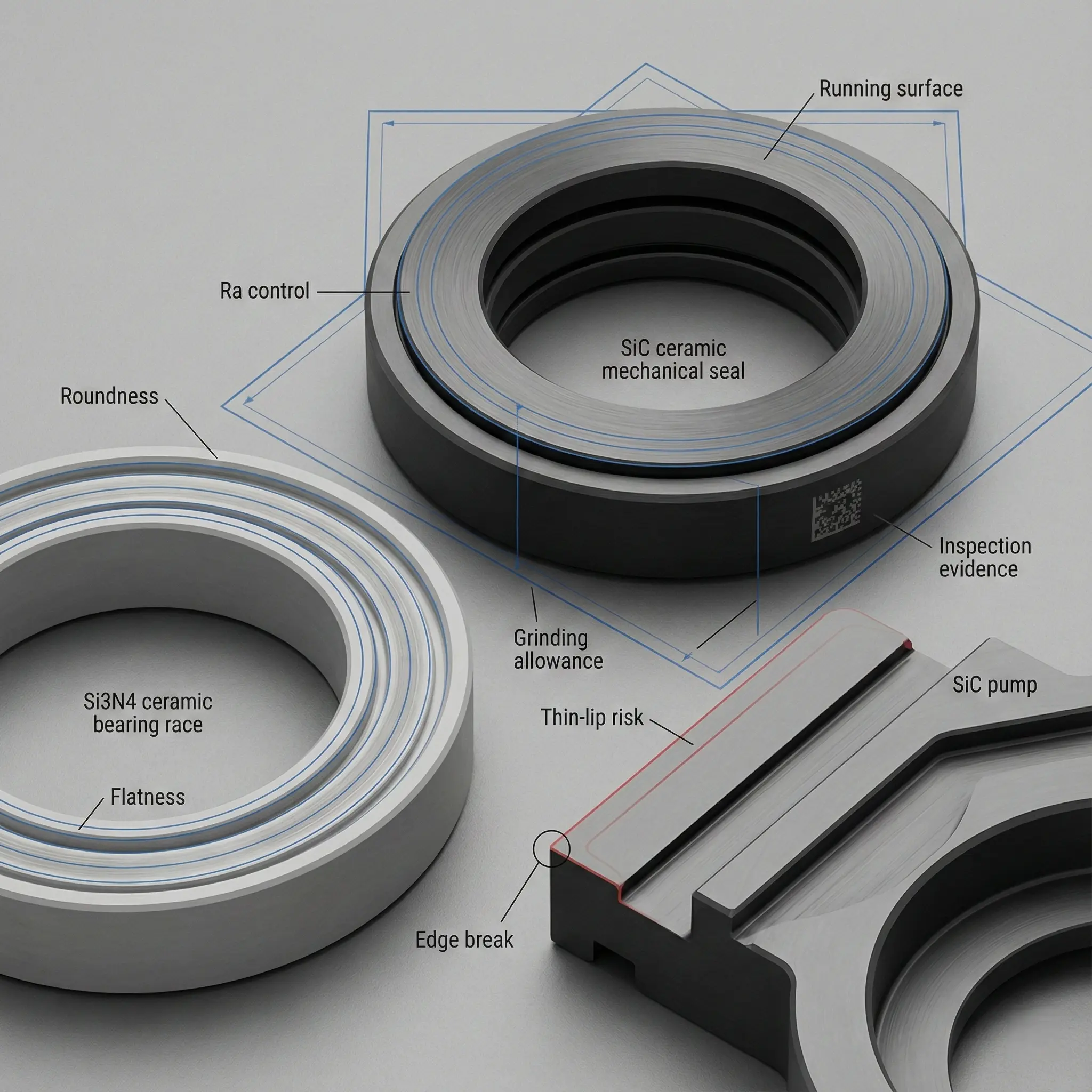
Wear and fluid-control ceramic parts work at interfaces: a bushing runs against a shaft, a seal face runs against a mating ring, a valve seat closes against a ball or plug, and a nozzle controls abrasive or corrosive flow. Material hardness alone does not define whether the component will work.
The drawing and RFQ should connect the dominant wear or leakage mechanism to the actual geometry. Roundness, concentricity, flatness, Ra, edge integrity, groove shape, port transitions, mating material, and media can all control service behavior and manufacturing cost.
This hub separates component families so buyers can move from a failed or wearing interface to the relevant machining, material, inspection, cleaning, and packaging questions.
Component families
These are not catalog promises. They are review paths for connecting geometry, material, process, and evidence to the function of the part.
ID/OD wear parts controlled by bore roundness, straightness, wall stability, alignment, running-surface finish, lead-ins, and counterface behavior.
SiC, alumina, or zirconia rings and seats with lapped bands, flatness, Ra, fit diameters, groove details, edge chips, paired-face context, and protected packaging.
Shutoff and throttling components reviewed around contact geometry, sphericity or roundness, lapped zones, port edges, particle exposure, and leakage boundary.
Sliding ceramic plungers, sleeves, inserts, and dosing parts where OD/ID fit, coaxiality, Ra, fluid cleanliness, and repeatable motion matter.
Long contact parts with straightness, flatness, slots, mounting holes, edge quality, replacement fit, and packaging risks beyond bulk wear resistance.
Abrasive or corrosive flow components controlled by bore geometry, taper, breakout, concentricity, port transitions, cleaning, and optical or flow acceptance.
Decision map
Use the final column as a drawing and RFQ check. A requirement is easier to review when its function and acceptance evidence are stated together.
| Requirement | Why it changes the route | What to define in the RFQ |
|---|---|---|
| Wear and media definition | Sliding, abrasion, erosion, impact, cavitation, thermal cycling, and chemical attack point to different material and finish decisions. | State media chemistry, particle size or solids, pressure, speed, temperature, lubrication, cycle, and observed failure mode. |
| Mating component and fit | A ceramic part cannot be reviewed in isolation when contact stress, clearance, leakage, or counterface wear controls function. | Provide mating material, dimensions, fit class or clearance, assembly method, contact band, and replacement constraints. |
| Functional surface geometry | Roundness, flatness, concentricity, straightness, and Ra are valuable only when tied to the running, guiding, or sealing surface. | Mark functional zones, datums, lapped bands, running surfaces, port edges, and the intended measurement method. |
| Edge, cleaning, and packaging | Chips at seal lands, bore lead-ins, or port exits can defeat function; residue and transit contact can damage finished surfaces. | Define edge breaks, allowable chip zones, cleaning, surface protection, individual separation, and inspection evidence. |
Material paths
Often reviewed for seal faces, valve trim, pump sleeves, nozzles, and abrasive or corrosive interfaces. Exact grade, blank route, lapping, and edge risk matter.
A practical baseline for bushings, liners, guides, seats, and general wear components. Purity, density, impact risk, and finished surfaces should be defined.
Considered for balls, plungers, sleeves, pins, and impact-sensitive wear parts where toughness and a smooth finish are useful.
May fit rollers, shafts, bushings, guides, and thermally cycled mechanical parts where strength, low density, and thermal shock resistance matter.
Quote-ready package
Engineering guides
Each guide below narrows one part family or manufacturing constraint and leads back to the drawing information needed for review.
Engineering guide for wear-resistant ceramic bushings, sleeves, and guide rings used in industrial machinery, including alumina, zirconia, silicon nitride, silicon carbide, ID/OD fit, roundness, Ra, counterface review, inspection evidence, packaging, and RFQ inputs.
Engineering guide for precision machined ceramic guide rails, wear strips, and guide blocks used in packaging machinery, conveyors, automation lines, and high-friction production equipment, including material choice, straightness, flatness, slots, mounting holes, edge quality, Ra, inspection, and RFQ inputs.
Engineering guide for precision ceramic seal faces, mechanical seal rings, mating rings, and lapped faces used in pumps, mixers, compressors, and rotating equipment, including SiC, alumina, zirconia, flatness, Ra, edge chips, inspection, packaging, and RFQ inputs.
Prepare ceramic valve seats, balls, and trim for quotation: define chemical and slurry duty, mating geometry, component inspection, and assembled-valve acceptance.
Design and RFQ guide for ceramic pump and valve components used in corrosive, abrasive, high-purity, and vacuum fluid systems, including SiC seal faces, zirconia balls, alumina seats, plungers, sleeves, lapping, and inspection.
RFQ guide for lapped ceramic seal faces, valve seats, vacuum interfaces, gasket lands, flatness, Ra, edge condition, subsurface damage, and leak-test expectations.
Engineering guide to industrial ceramic machining for wear-resistant components, including material choice, geometry, surface finish, edge quality, inspection, and RFQ inputs.
How engineers should specify silicon carbide ceramic machining for seal faces, valve seats, pump parts, nozzles, wear plates, wafer handling components, and harsh environment equipment.
How engineers should specify zirconia ceramic machining for high-strength pins, plungers, bushings, sleeves, valve parts, wear components, fixtures, and precision mechanisms.
How engineers should specify custom silicon nitride rollers, shafts, bearing-adjacent parts, sleeves, bushings, guides, and structural wear components.
How to prepare an RFQ for precision ceramic micro-hole machining, micro-drilling, gas distribution plates, vacuum chucks, nozzles, orifice plates, and inspection evidence.
Questions before quotation
There is no universal best material. SiC, alumina, zirconia, and other ceramics have different wear, corrosion, toughness, blank, finish, and cost tradeoffs. Media, particles, temperature, pressure, geometry, and mating surfaces must be reviewed together.
Provide the drawing, material, mating face, lapped or sealing zone, flatness, Ra, fit dimensions, media, pressure, temperature, edge criteria, quantity, inspection method, and protected-packaging requirement.
Usually not. Tight finish should be assigned to running, guiding, sealing, or cleanability-critical zones. Applying the same Ra to nonfunctional relief and exterior surfaces can add unnecessary grinding and inspection cost.
Include material or operating environment, quantity, target timing, functional surfaces, tolerance and finish priorities, cleaning, packaging, and inspection evidence. Feasibility, price, and lead time are confirmed after review.