RFQ inputs
Send enough information for a practical ceramic CNC quote
A simple drawing and quantity may be enough to start review. For precision ceramic parts, include the requirements that affect blank source, material route, grinding allowance, surface finish, edge quality, and inspection.
Engineering RFQ
Send your drawing and ceramic requirements for engineering review
Start with the part function, material or grade if known, quantity, and the critical requirements; an early-stage brief is enough to begin. If online submission is interrupted, the form prepares the same RFQ as an email instead.
- Useful files: STEP/STP, X_T/X_B, IGES, STL, or PDF drawings.
- Upload limit: up to 3 files, 5 MB each, 8 MB total.
- Sensitive projects: do not send export-controlled, classified, or restricted data before an approved handling agreement is in place.
Prefer to use your own email?
RFQ email: info@szcomo.com
RFQ email prepared
Send it from your email app
Your email app should now show a message to info@szcomo.com with these details. Attach CAD or drawings and press send. If nothing opened, copy the text below into an email to info@szcomo.com.
Email format
Use this structure if it helps.
Send the drawing and what you know. Unknown fields can stay blank.
Subject: Precision Ceramic CNC RFQ - [material/grade] - [quantity] - [target date]

Hello CERAMIC CNC,

Please review the attached CAD/drawings for quotation.

Part/application:
Ceramic material, grade, and fired state:
Customer-supplied blanks or sourcing requested:
Attached files:
Quantity:
Target lead time:
Critical dimensions, datums, and GD&T:
Surface finish, flatness, or lapping requirements:
Cylindrical fits, plungers, sleeves, or seal interfaces:
Micro-holes, slots, thin walls, or edge-break requirements:
Operating environment:
Fluid, gas, slurry, dispensing media, or cleaning method:
Cleanliness, packaging, or contamination limits:
Inspection method, documentation, and certificate requirements:
Acceptance criteria or sampling plan:
Ship-to country/region:

Notes:

Best regards,
Practical inputs
RFQ review flow
Send the drawing first. Add the ceramic-specific requirements that affect quotation and acceptance.
How we handle different RFQs
The response depends on whether the drawing, material route, functional surfaces, and acceptance evidence are clear.
Simple drawing quote
If material, geometry, quantity, and standard tolerances are clear, we can review the project for quotation with route assumptions.
Clarification needed
If datums, edge condition, surface finish, material grade, micro-features, or inspection needs are missing, we ask before quoting.
Complex project review
For sealing, vacuum, semiconductor, micro-hole, or tight flatness requirements, feasibility notes and inspection scope are part of the quote path.
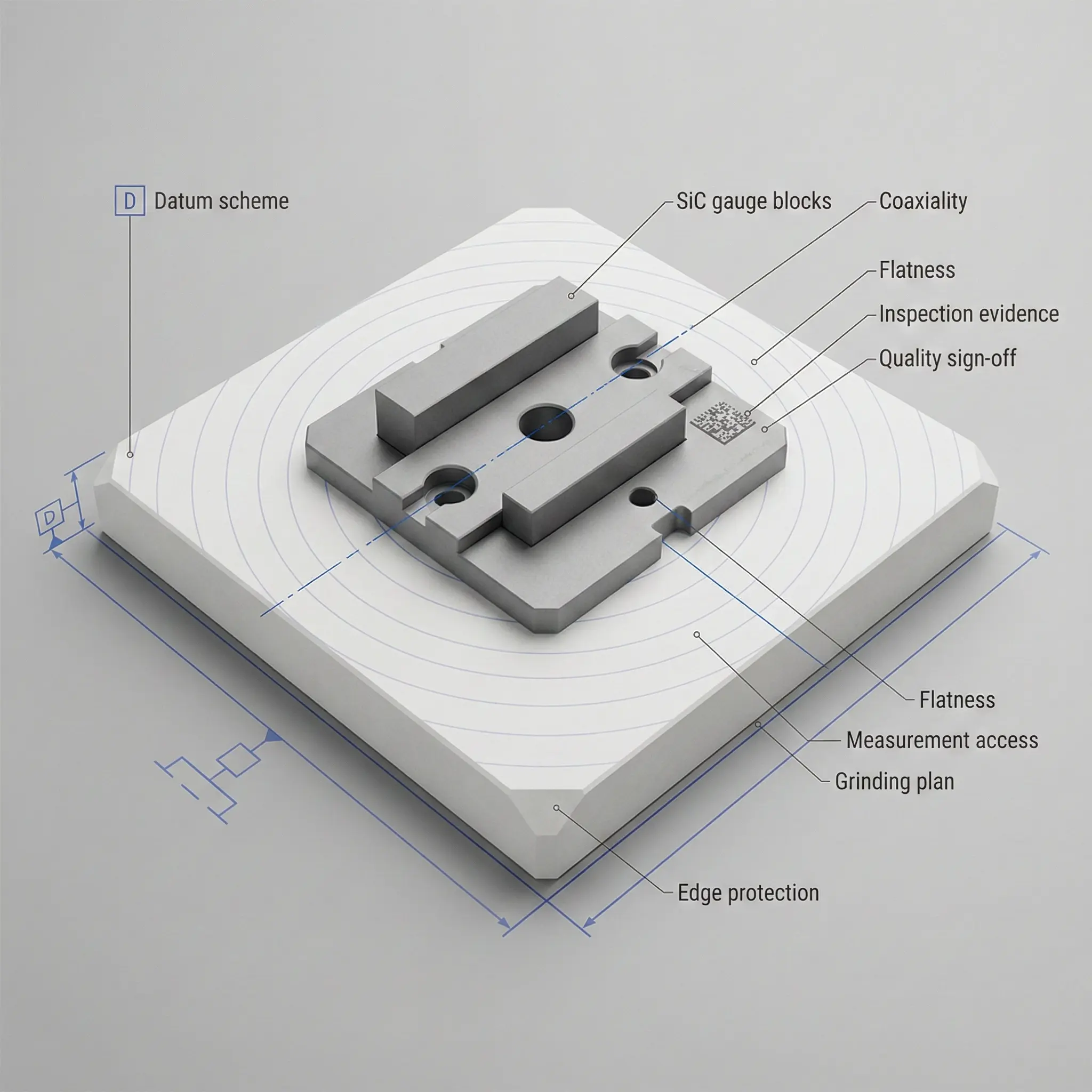
Information that helps quotation
Send what you have and clearly mark what is function-critical. Leave unknown fields blank rather than guessing.
Geometry package
STEP, IGES, native CAD, and 2D drawings with revision, datums, GD&T, critical interfaces, and inspectable features.
Functional requirements
Temperature, media chemistry, wear/erosion, vacuum, dielectric, thermal cycling, flow, dispensing, sealing, or assembly constraints.
Acceptance evidence
CMM, optical, profile, pin gauge, surface finish, flatness mapping, CoC, available material certificate, CT when justified, or key-dimension report.
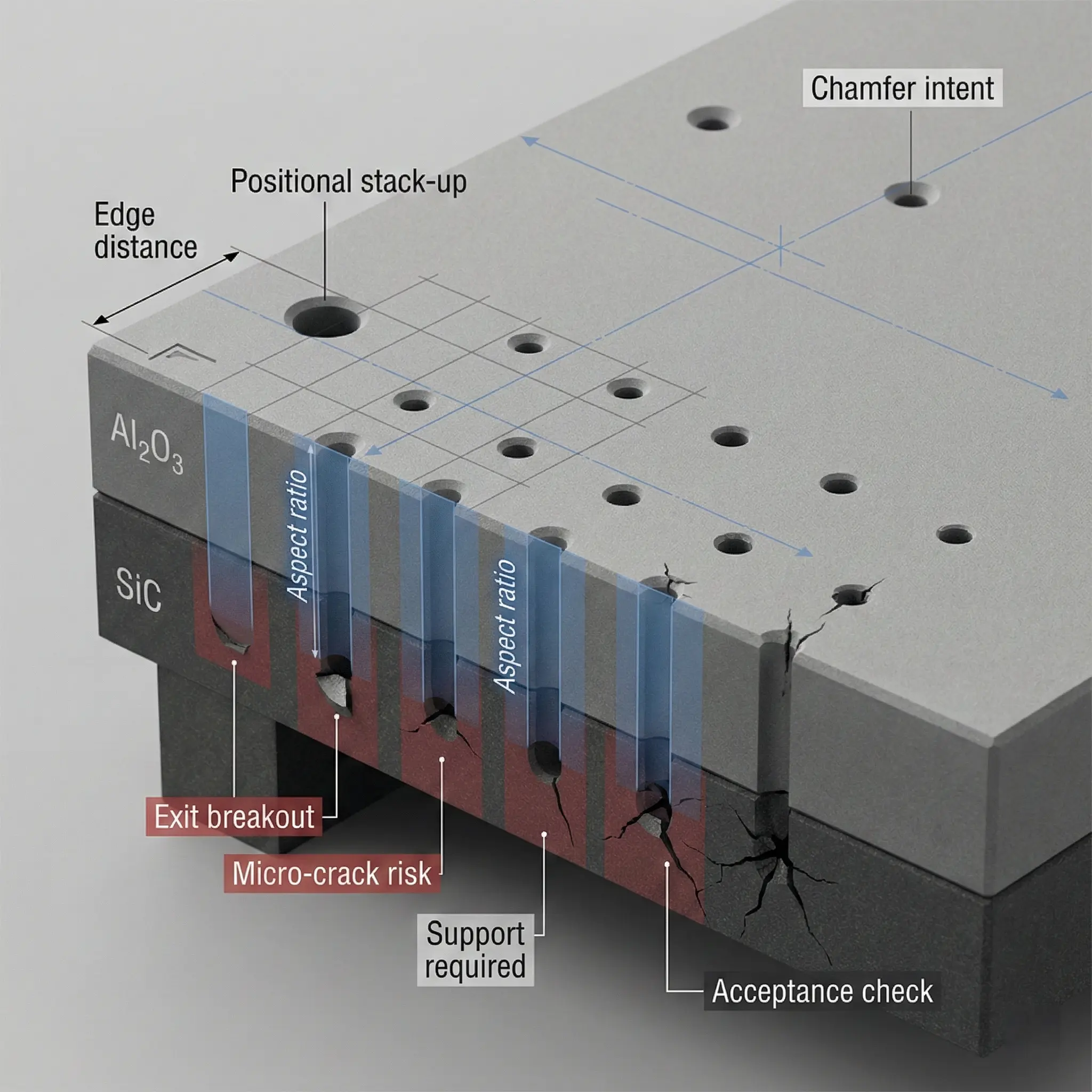
RFQ FAQs
These questions usually determine whether a ceramic CNC RFQ can be reviewed without avoidable back-and-forth.
What information should be included in a ceramic CNC RFQ?
Send material and grade, blank or sourcing requirement, drawing revision, STEP or IGES files, functional datums, GD&T, critical faces, quantity, lead time, surface finish, inspection scope, and application constraints such as temperature, media, wear, vacuum, or insulation.
How can I reduce quote back-and-forth?
Mark the functional faces and datums, define surface finish per face, list micro-holes or thin-wall features, state edge condition, and specify how each critical requirement will be inspected.
What are the main cost drivers in ceramic CNC machining?
Cost is usually driven by diamond grinding or lapping time, micro-features, tight GD&T across multiple faces, low Ra requirements, brittle failure risk, inspection time, and blank availability.
When does green machining reduce cost or lead time?
Green machining may reduce shaping cost before sintering when a suitable preform route and shrinkage data are available. Tight seal faces, bearing fits, or datum faces usually still need post-sinter finishing.
When should a drawing use as-sintered dimensions?
Use as-sintered dimensions for non-critical surfaces and moderate tolerance features. Use post-sinter grinding or lapping for seal faces, bearing interfaces, flatness, parallelism, and measurable datums.
What lead time should be planned?
Lead time is estimated after review of blank sourcing, customer-supplied material status, preform route, post-sinter grinding, lapping, polishing, micro-hole work, and metrology scope. Inspection often controls schedule for tight parts.
What should be specified for ceramic plungers, sleeves, and pump parts?
State the media, pressure or flow role, mating seal or sleeve, OD/ID fit, roundness, straightness, Ra, chamfer, cleaning, packaging, and inspection evidence. For dispensing or injection-pump parts, do not quote only by outside dimensions.
How should quotes from different suppliers be compared?
Normalize material grade, route, datum scheme, tolerance map, Ra per functional face, inspection method, documentation, and packaging requirements. Low quotes often exclude finishing or evidence.
Which ceramics are commonly machined?
Common precision ceramics include alumina, zirconia, silicon nitride, silicon carbide, aluminum nitride, boron nitride, fused silica, and selected machinable glass ceramics.
How do I choose between alumina and zirconia?
Alumina is often used for insulation, wear resistance, and cost efficiency. Zirconia is often chosen when toughness and reduced chipping risk matter more.
When is silicon nitride a strong candidate?
Silicon nitride fits bearing, wear, and thermally cycled parts where strength retention, shock resistance, and lower chipping risk are important.
When should SiC be considered?
SiC fits extreme wear, high temperature, and chemical service, but it is very hard to finish. Apply tight tolerances and low Ra only where function requires them.
Related RFQ guides
Use these when the project needs more than a simple drawing-and-quantity quote.
Custom Ceramic CNC Machining RFQ Checklist
Use this to prepare drawings, material notes, quantity, functional surfaces, tolerances, finish, and inspection evidence.
Ceramic Material Selection for CNC Machining
Use this when the material is not fixed or when alumina, zirconia, Si3N4, SiC, AlN, Macor, or BN are being compared.
Ceramic CNC Machining Design Rules
Use this before sending metal-style features, sharp corners, thin walls, hole patterns, slots, or unclear datum schemes.
Ceramic Tolerance Capability Map
Use this to separate functional precision from general geometry and to align tolerance with route and measurement method.
Surface Finish and Subsurface Damage
Use this when Ra, lapping, polishing, microscopy, seal faces, sliding faces, or surface integrity affect acceptance.
Green Machining vs Hard Machining
Use this when the blank route, shrinkage, post-sinter grinding, final datums, or lead time assumptions affect the quote.
Micro-Hole Machining RFQ Guide
Use this for gas plates, vacuum features, nozzles, tiny bores, hole arrays, taper, breakout, cleaning, and inspection.
Thin-Wall Sleeve Machining RFQ Guide
Use this for thin sleeves, bores, OD/ID concentricity, roundness, wall stability, edge quality, and handling risk.
Pump and Valve Component RFQ Guide
Use this for ceramic plungers, sleeves, valve seats, seal faces, metering inserts, dispensing parts, corrosive fluids, Ra, roundness, and leakage risk.
Ceramic CNC Machining Buyer Guide
Use this for procurement-level review of capability, cost drivers, lead time, inspection packets, and acceptance gates.
Send the drawing and requirements
Email info@szcomo.com with CAD, drawings, material grade, blank or sourcing requirement, quantity, target lead time, critical surfaces, edge requirements, and inspection expectations. We review the information before confirming feasibility, price, or schedule.