Alumina standoffs and spacers
Insulating supports, sleeves, plates, and housings controlled by bore fit, mounting faces, edge radius, creepage, clearance, and cleanliness.
Electrical and thermal systems
Connect electrical isolation, thermal transfer, mechanical assembly, and inspectable ceramic geometry before fixing material or tolerance.
Application review
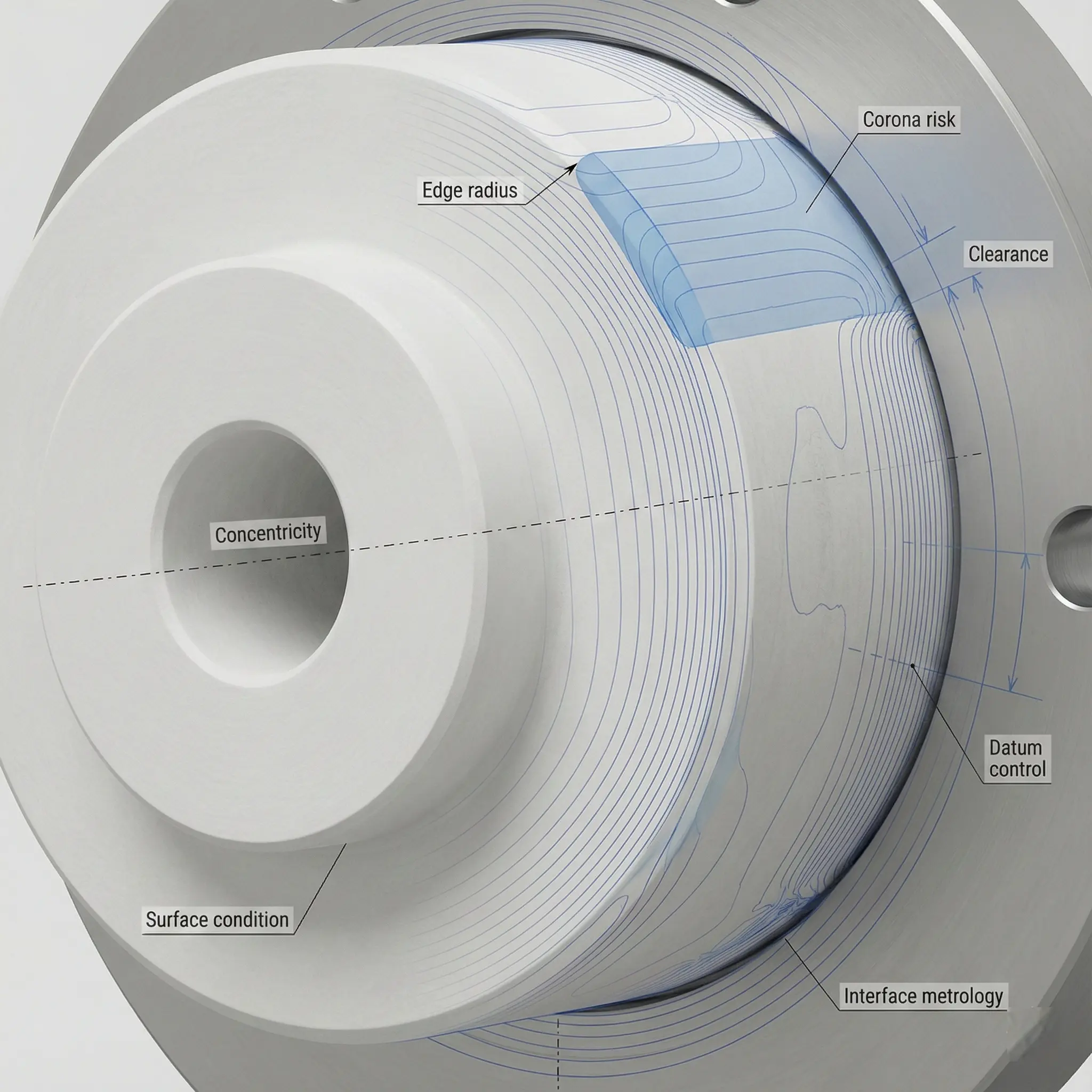
Electrical and thermal ceramic parts often carry conflicting requirements. A heat spreader may need high thermal conductivity, dielectric isolation, tight thickness, and a flat interface. A feedthrough insulator may need a precision bore, sealing shoulder, creepage path, clean surface, and controlled assembly stress.
The RFQ should separate electrical, thermal, mechanical, and cosmetic zones. This prevents a blanket tolerance or finish note from adding cost to nonfunctional surfaces while leaving the critical interface ambiguous.
Material selection should follow the operating environment and failure mode. Alumina, AlN, silicon nitride, Macor, and other ceramics have different blank availability, machining response, edge sensitivity, thermal behavior, and inspection needs.
Component families
These are not catalog promises. They are review paths for connecting geometry, material, process, and evidence to the function of the part.
Insulating supports, sleeves, plates, and housings controlled by bore fit, mounting faces, edge radius, creepage, clearance, and cleanliness.
Ceramic bodies and sleeves where conductor fit, sealing lands, vacuum interfaces, electrical spacing, cleaning, and assembly stress interact.
Thermal-interface plates and insulating carriers reviewed for grade, thickness, flatness, Ra, holes, edge quality, cleaning, and protected packaging.
Ribbed insulators, creepage paths, clearances, slots, lead-ins, and mounting transitions that need realistic radii and measurable chip criteria.
Alumina and other ceramic nests, support plates, locating pins, and inspection fixtures used around SiC or GaN module assembly and test.
Insulating plates, spacers, windows, mounts, and sensor supports controlled by dielectric spacing, flatness, position, clean assembly, and documentation.
Decision map
Use the final column as a drawing and RFQ check. A requirement is easier to review when its function and acceptance evidence are stated together.
| Requirement | Why it changes the route | What to define in the RFQ |
|---|---|---|
| Electrical isolation path | Creepage, clearance, contamination, chips, and sharp transitions can matter as much as the bulk dielectric property. | Mark voltage context, conductive neighbors, creepage path, clearance zones, edge radii, and cleaning requirement. |
| Thermal interface | Flatness, thickness, Ra, mounting pressure, and mating materials affect contact more directly than a generic polished-surface note. | Identify thermal faces, datum scheme, interface material, flatness condition, thickness map, and required measurements. |
| Bores and assembly fits | Press fits, conductor fits, and rigid mounting can put tensile stress into brittle ceramic edges and shoulders. | Provide mating dimensions, fit intent, assembly method, lead-ins, torque or preload context, and inspection basis. |
| Surface and cleanliness | Residue, handling damage, or ambiguous finish can affect insulation, thermal contact, vacuum use, and customer assembly yield. | Define functional Ra, visual criteria, cleaning, bagging, contact protection, and certificate or report needs. |
Material paths
A common insulation baseline for spacers, sleeves, plates, standoffs, and feedthrough-adjacent parts. Purity, density, and finished faces should be stated.
Chosen where heat transfer and electrical isolation must coexist. Grade, blank route, thermal faces, edge condition, and handling need explicit review.
May fit mechanically loaded, thermally cycled, or fixture applications. Electrical and thermal assumptions must be tied to the exact grade.
Useful for prototypes, laboratory hardware, and low-volume insulating parts when ordinary machining and design iteration matter more than maximum service performance.
Quote-ready package
Engineering guides
Each guide below narrows one part family or manufacturing constraint and leads back to the drawing information needed for review.
Engineering guide for precision machined alumina ceramic insulators used in electrical and electronic assemblies, including standoffs, spacers, sleeves, plates, housings, creepage paths, edge quality, cleaning, inspection, and RFQ inputs.
RFQ guide for machined alumina, AlN, and other ceramic plates used in RF and microwave assemblies, including flatness, thickness, holes, finish, and inspection.
Engineering guide to aluminum nitride heat spreaders for power electronics, SiC and GaN modules, AI data center power conversion, thermal-interface flatness, thickness, Ra, cleaning, packaging, and RFQ review.
Engineering guide for precision machined ceramic feedthrough insulators used in vacuum, high-voltage, semiconductor, laboratory, and electrical systems, including alumina sleeves, bore fit, sealing lands, creepage paths, cleaning, packaging, and RFQ review.
How to prepare RFQs for high-voltage ceramic insulators, spacers, sleeves, standoffs, power electronics fixtures, creepage paths, edge quality, and inspection.
RFQ guide for precision ceramic parts used around AI data center power electronics, SiC power modules, high-voltage insulation, thermal interfaces, and test fixtures.
Illustrative RFQ guide for alumina inspection fixtures used around SiC power-module assembly: datum pads, locating bores, insulation, thermal contact, edge quality, and inspection evidence.
Engineering guide to aluminum nitride ceramic parts for semiconductor thermal management, including AlN heat spreaders, heater-adjacent plates, flatness, Ra, cleaning, packaging, inspection evidence, and RFQ review.
How engineers should specify aluminum nitride ceramic machining for heat spreaders, insulating plates, substrates, spacers, carriers, power electronics fixtures, and thermal-interface components.
How engineers should specify precision machined alumina ceramic parts for insulation, wear, vacuum, sensors, fixtures, high-temperature systems, and industrial assemblies.
How to select ceramic materials for CNC machining by failure mode, finishability, blank state, tolerance risk, and inspection requirements.
Questions before quotation
AlN is commonly considered when thermal transfer and electrical isolation must coexist. Alumina may remain the more practical choice when insulation, wear, availability, and cost dominate. The exact grade, geometry, and interface requirements need review.
No. Voltage context is only one input. Creepage, clearance, surface condition, contamination, conductor geometry, mounting stress, temperature, material grade, and inspection criteria also affect the part and quotation.
Usually only the thermal-contact and datum interfaces need the tightest control. The drawing should identify those faces, the support condition, thickness relationship, Ra target, and measurement method before feasibility is confirmed.
Include material or operating environment, quantity, target timing, functional surfaces, tolerance and finish priorities, cleaning, packaging, and inspection evidence. Feasibility, price, and lead time are confirmed after review.