Published · CERAMIC CNC Engineering · Engineering Guide · 12 min read
Machinable Ceramics Compared: MACOR, Machinable AlN, Boron Nitride and Pre-Sintered Blanks
Which machinable ceramic fits a prototype or low-volume part, and when the drawing should move to a dense sintered ceramic. Compares MACOR, Shapal Hi M-soft, hot-pressed BN and pre-sintered blanks by temperature, strength, heat flow, moisture and RFQ inputs.
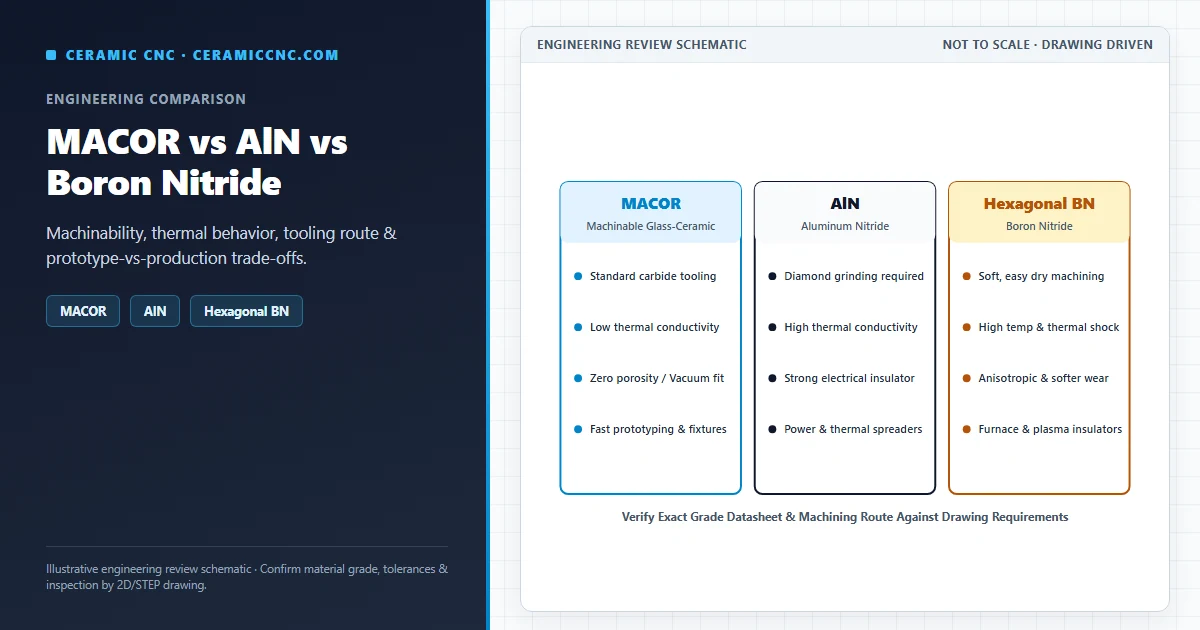
A machinable ceramic is the right choice when the part needs ceramic-like insulation or temperature resistance, the quantity is low, and the geometry is still changing. It is the wrong choice when the part must carry real load, resist wear or strong chemicals, or survive long service above the material’s stated limit. Between the machinable options, the decision usually comes down to four inputs: service temperature and atmosphere, required strength, whether heat must flow through the part, and whether the part will see moisture or a vacuum bake.
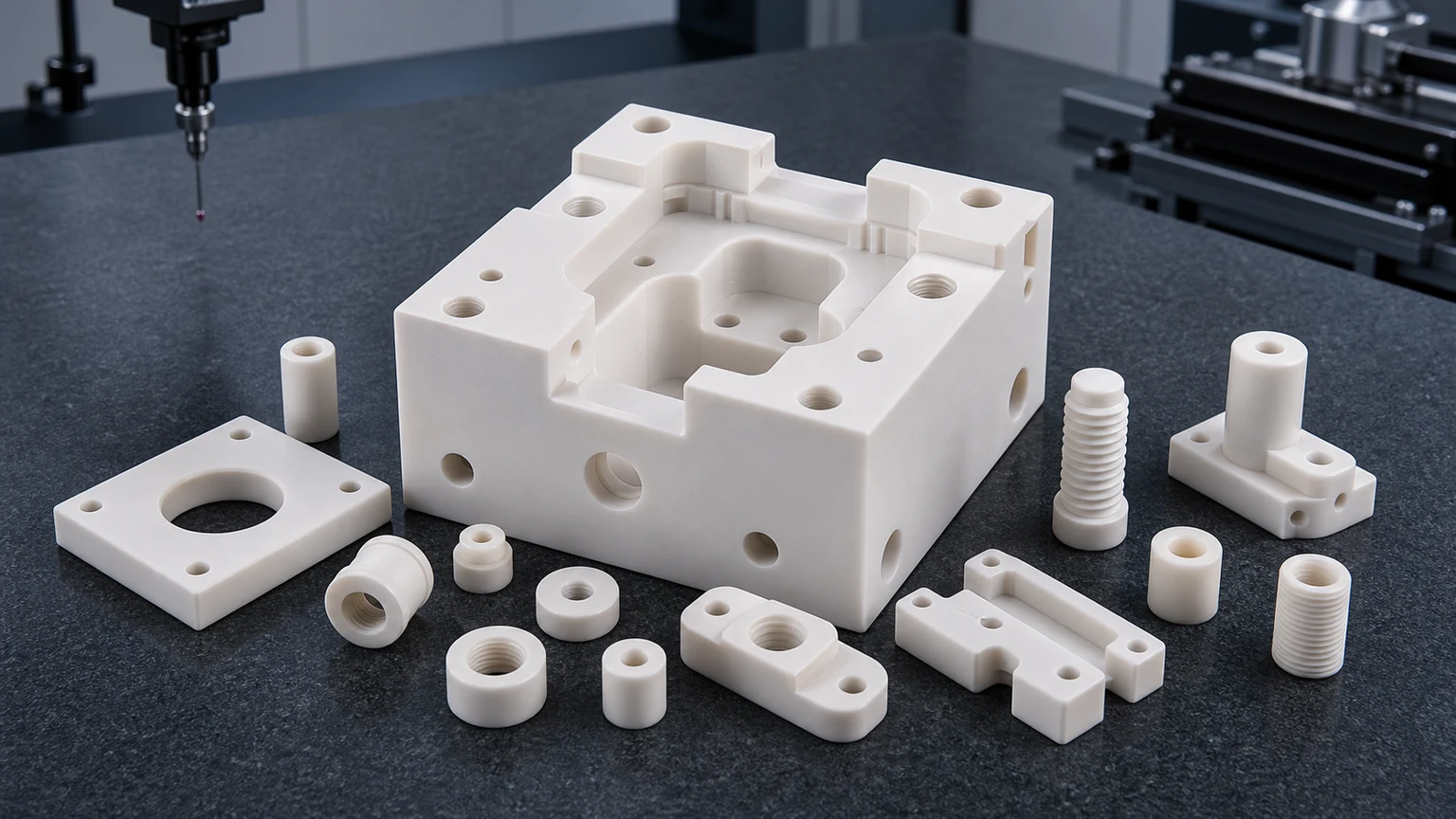
“Machinable ceramic” covers several different materials. They share one practical trait: they can be shaped with carbide or high-speed steel tools instead of diamond grinding. They do not share strength, temperature limits, thermal conductivity, moisture behavior or price. Ordering “a machinable ceramic” without naming the grade leaves the most important decision to the supplier.
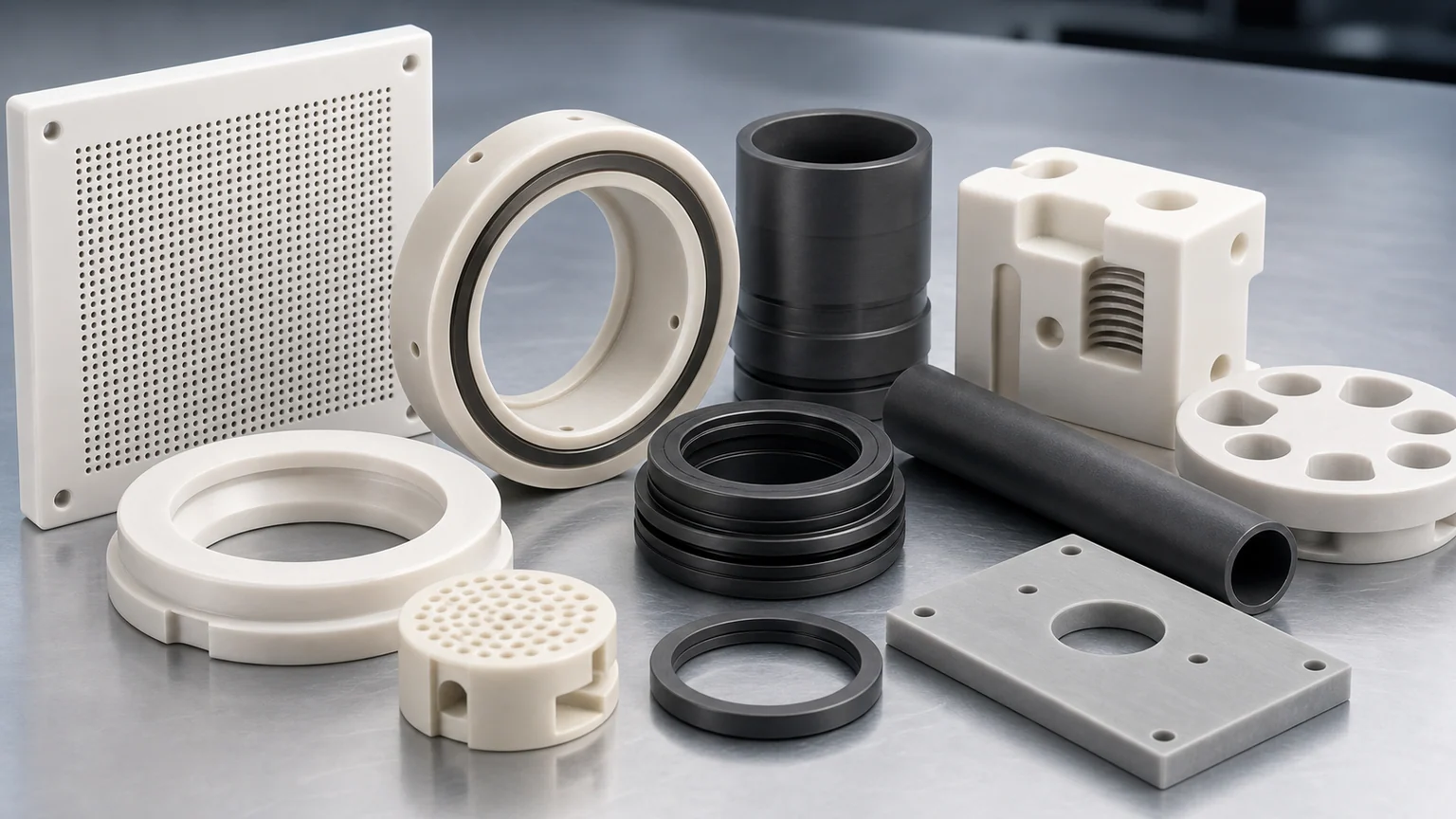
This guide compares the four routes buyers usually mean:
- MACOR machinable glass ceramic (Corning).
- Machinable aluminum nitride, here Tokuyama’s Shapal Hi M-soft, an AlN-based composite with boron nitride.
- Hot-pressed hexagonal boron nitride, which comes in several binder grades.
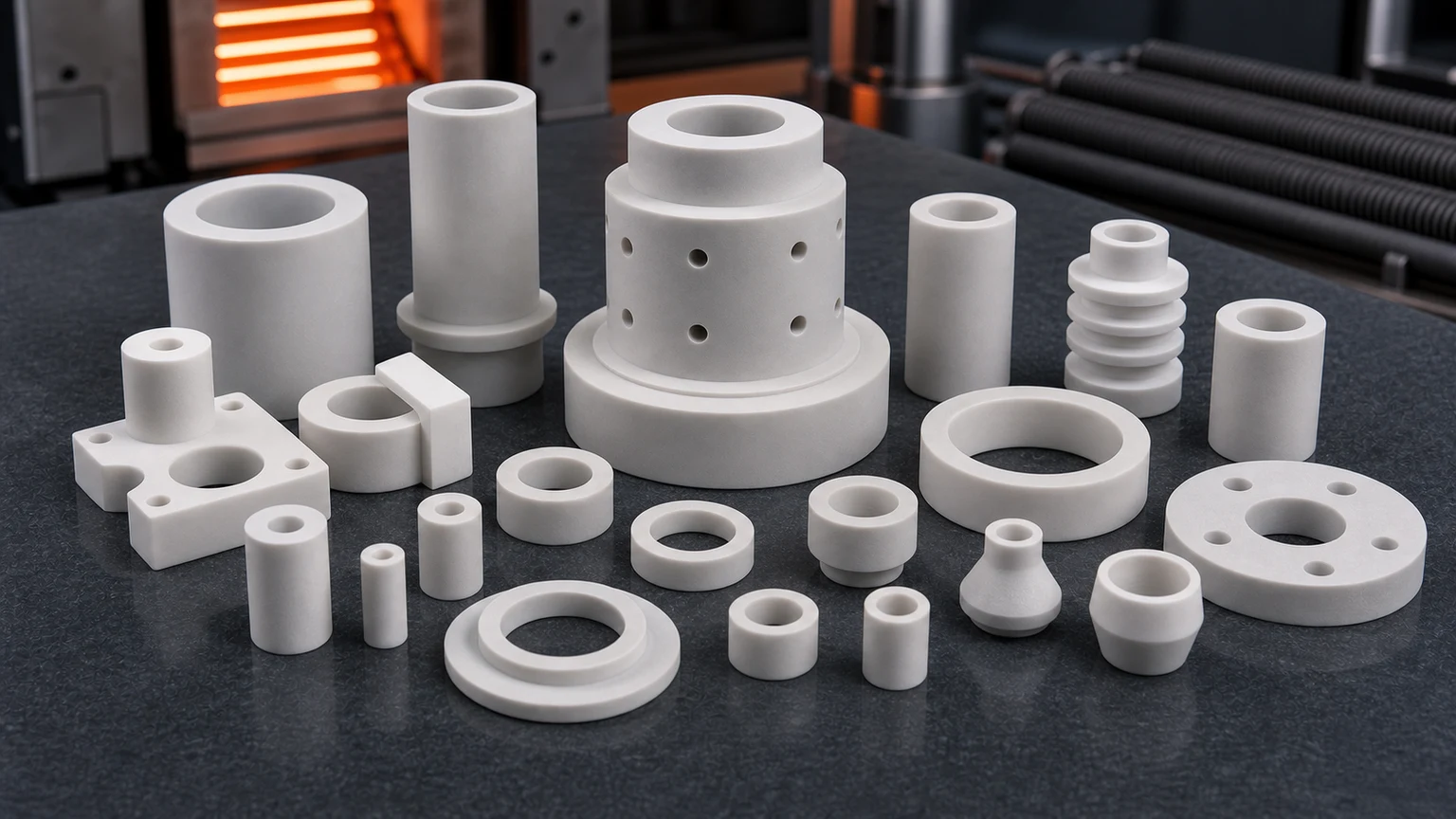
- Pre-sintered or green blanks of alumina, zirconia and other dense ceramics, machined before final firing.
Material details for each one are covered in their own guides: the MACOR design guide, the boron nitride machining guide and the green versus hard machining guide. This page is the comparison you use before choosing one of them. If you already have a STEP or PDF drawing and want to confirm whether MACOR, Shapal, BN, or a sintered ceramic fits your duty, send the drawing for engineering review.
Decision Table
Start with the requirement that the part cannot give up. The table shows which route usually fits first. It is a review starting point, not a material approval.
| If the part mainly needs… | Usually review first | Why | Watch for |
|---|---|---|---|
| Electrical insulation and quick geometry changes, moderate temperature | MACOR | Zero porosity, machined without firing, low thermal conductivity | Low strength; attack by hot acids; fluorine release in vacuum above about 600 °C |
| Insulation and heat flow through the part | Machinable AlN (Shapal Hi M-soft) | Distributor typical data puts thermal conductivity near 92 W/m·K at 25 °C, versus about 1.5 for MACOR | Higher material cost; anisotropy and grade data come from distributors, not one datasheet |
| Very high temperature in inert or vacuum atmosphere, non-wetting by melts | Hot-pressed BN (grade matters) | Inert-atmosphere limits of 1150–2000 °C depending on binder grade in one supplier’s data | Low strength in pure grades; moisture uptake in boric-oxide-bonded grades; 850 °C in air |
| Final production properties of alumina or zirconia, but complex shape | Pre-sintered / green blank, then finish-grind | Shape is cut while soft, then the part densifies to full ceramic properties | Firing shrinkage and distortion; functional faces still need diamond grinding after firing |
| Load, wear, seal faces, strong chemicals, tight tolerances in production | Dense sintered ceramic, diamond ground | None of the soft-machinable materials matches dense alumina, zirconia, SiC or Si3N4 here | Higher machining cost per feature; design must suit grinding |
If two rows apply, the stricter row usually wins. A fixture that must insulate at 900 °C in air and also carry a clamp load is outside MACOR’s continuous rating and too weak in most BN grades. It needs a dense ceramic review.
What The Published Data Shows
The values below are typical supplier data at room temperature unless stated. They come from different publishers using different test methods, so use them to rank options, not as acceptance values. Every number belongs to the named grade only.
| Property | MACOR (Corning datasheet) | Shapal Hi M-soft (distributor typical data) | Hot-pressed BN, Accuratus grade BO | 99.5% alumina, Accuratus typical data |
|---|---|---|---|---|
| Flexural strength | 94 MPa (minimum specified average) | about 300 MPa | 75.8 / 113 MPa (parallel / perpendicular to pressing) | 379 MPa |
| Thermal conductivity | 1.46 W/m·K | 92 W/m·K | 30 / 33 W/m·K | 35 W/m·K |
| Thermal expansion | 9.3 × 10⁻⁶/°C (25–300 °C) | 4.8 × 10⁻⁶/°C (RT–400 °C) | 11.9 / 3.1 × 10⁻⁶/°C | 8.4 × 10⁻⁶/°C |
| Stated temperature limit | 800 °C continuous; 1000 °C maximum, no load | 1000 °C in air; 1900 °C non-oxidizing | 1200 °C inert atmosphere; 850 °C oxidizing (all BN) | 1750 °C, no load |
| Porosity | 0% | 0% | 2.8% | 0% |
| Shaped with conventional tools | Yes; carbide recommended for tool life | Yes; carbide tools | Yes; carbide tools | No; diamond grinding after firing |
Three points matter more than any single number:
- Strength spread is large. In this data the dense alumina is about four times stronger than MACOR, and the binder-free BN grade XP from the same BN supplier is far weaker than grade BO (13.8 / 21.4 MPa). A thin wall, a tapped hole or a clamp face can fail in a soft-machinable material even when the bulk value looks adequate.
- Heat flow separates MACOR and machinable AlN. MACOR is a thermal insulator. Shapal Hi M-soft conducts heat about 60 times better in this data. If the part is a heat-sink, heater support or thermal path, MACOR is the wrong prototype material even if the geometry is identical.
- BN is directional. Hot-pressed BN properties differ parallel and perpendicular to the pressing direction. Expansion in grade BO is almost four times higher in one direction than the other. The drawing or RFQ should say which face or axis carries heat or load so the blank can be oriented.
The two Shapal distributors used here list flexural strength as 300 MPa and 320 MPa respectively, which is a reminder that distributor sheets are guidance only. Ask for the current manufacturer or distributor datasheet with the quote.
MACOR: When It Fits And When It Does Not
MACOR is a mica–borosilicate glass ceramic. Corning states it machines with ordinary metalworking tools, needs no firing after machining, has zero porosity and does not outgas once properly baked out. That makes it a common choice for insulating spacers, coil forms, vacuum test hardware and fixture prototypes.
Limits to check before you commit:
- Temperature. 800 °C continuous and 1000 °C peak without load (Corning). Accuratus notes that in vacuum above about 600 °C, fluorine can be released as boron trifluoride or hydrofluoric acid. For vacuum furnaces or heated sample stages, state the bake and operating temperature in the RFQ.
- Chemistry. Corning’s own test data shows heavy weight loss in 5% HCl at 95 °C over 24 hours (about 100 mg/cm²) and moderate loss in 5% NaOH at 95 °C over 6 hours (about 10 mg/cm²). Hot water that is not refreshed also attacks it over days. Parts that see hot acids, caustic cleaning or long hot-water exposure need a different material.
- Strength. At 94 MPa, MACOR suits low-stress parts. Threads, press fits and thin flanges need conservative design. The MACOR design guide covers hole, thread and pocket rules.
Machinable AlN: When Heat Must Move Through The Part
Tokuyama describes Shapal Hi M-soft as a machinable aluminum nitride whose lamellar crystal particles stop surface cracks from carbide cutting tools from going deeper into the material. Distributor data adds high flexural strength for a machinable ceramic, thermal conductivity near 92 W/m·K at 25 °C (falling to 55 W/m·K at 500 °C), and low thermal expansion.
It is worth reviewing when:
- A prototype heat spreader, heater support or thermal fixture must behave thermally like the final AlN part.
- An insulating part must also be stiff and stronger than MACOR.
- Low thermal expansion is needed for a setter, jig or alignment part.
It is not a drop-in substitute for dense sintered AlN substrates. The same Ishihara Chemical table that lists 92 W/m·K for Shapal Hi M-soft lists 177 W/m·K for its sintered AlN, and the machinable material is a composite. If the production part will be sintered AlN, specify flatness, thickness and thermal-interface requirements for that material, and treat the machinable AlN prototype as a geometry and fit check, not proof of final thermal performance.
Hot-Pressed BN: Temperature First, Strength Second
Boron nitride is chosen for very high temperatures in inert or vacuum atmospheres, for electrical insulation at temperature and for its non-wetting behavior with many molten metals. The grade decides almost everything. In Accuratus’s published data, the boric-oxide-bonded grade BO absorbs moisture, which causes swelling and property loss, while the calcium-borate-bonded grade CA is moisture resistant and the binder-free grade XP reaches the highest temperature but has the lowest strength. All BN grades in that data are limited to 850 °C in oxidizing atmospheres.
The boron nitride machining guide gives the full grade table and design rules. For this comparison the key questions are:
- Is the atmosphere inert, vacuum or air? Air above 850 °C rules BN out in this data.
- Will the part sit in humid storage or see water-based cleaning? That points away from boric-oxide-bonded grades or requires dry storage and a bake.
- Does it carry load? Pure grades are much weaker than bonded grades.
Pre-Sintered And Green Blanks: Machinable Now, Dense Later
A different route is to machine alumina, zirconia or another dense ceramic before final firing. Kyocera’s production overview describes the sequence: the powder compact is shaped, then fired, and the part shrinks as porosity closes; after sintering, cutting needs diamond wheels and considerable energy. That is why complex features are often cut before firing.
This route gives final dense-ceramic properties, which none of the three materials above can. The trade-offs are different:
- Firing shrinkage and distortion must be allowed for, so as-fired dimensions are looser than ground dimensions.
- Functional faces, bores and fits usually still need diamond grinding or lapping after firing.
- Blank supply, shrinkage control and firing are part of the route, which suits repeat production more than one-off prototypes.
The green versus hard machining guide explains when to cut before firing and how to split features between the two stages. Shrinkage values are grade- and process-specific and are not given here.
Machining Route And Feature Risks
Soft-machinable does not mean metal-like. Every material in this comparison is brittle.
| Feature | Risk in soft-machinable ceramics | Drawing or RFQ action |
|---|---|---|
| Hole exits and drilled breakout | Chipping where the drill exits; Corning advises leaving extra stock on the exit side | Mark which hole edges are functional; allow chamfers on exits |
| Tapped threads | Thread crests chip; Corning advises a tap drill one size larger than for metal and chamfering both ends | State fastener, torque and assembly frequency; consider inserts or through-bolts |
| Thin walls and webs | Breakage during clamping or assembly, especially in weak BN grades | Give the minimum wall that function needs, not the minimum that fits the model |
| Sharp internal corners | Stress concentration and cracking | Specify radii wherever function allows |
| Edges near load or seal faces | Edge chips reduce contact area and start cracks | Specify edge break and acceptable chip size on functional edges only |
| BN directional properties | Part cut in the wrong orientation behaves differently | State load and heat directions so the blank can be oriented |
| Pre-sintered features | Position shifts and distortion during firing | Identify features that must be ground after firing |
For precision faces on any of these materials, specify Ra, flatness and subsurface damage only where the function needs them.
Published Performance Is Not Acceptance
Datasheet values describe test bars made by the material producer, not your part. A drawing should not say “MACOR, 94 MPa” and expect each part to be tested to it. Separate the two:
- Material identity: name the grade and supplier, and ask for a material certificate or traceability to the stock lot.
- Part acceptance: dimensions, flatness, surface finish, edge condition and cleanliness on the finished part, measured by an agreed method.
- Functional proof: thermal, electrical or vacuum performance tests belong to the customer’s system test unless a specific test is agreed in the RFQ.
When To Move To A Dense Sintered Ceramic
Plan the switch from the start if any of these apply to the production part:
- Mechanical load, impact, sliding wear or abrasive media.
- Seal faces or fits that must hold flatness or clearance over long service.
- Hot acids, caustic cleaning or repeated hot-water exposure.
- Continuous service in air above the machinable material’s stated limit.
- Production volume where per-part machining time matters more than iteration speed.
The materials page compares dense ceramics for these duties. If the prototype is in a machinable material and the production part will not be, tell the supplier early: threads may need to become inserts, sharp pockets may need radii, and tolerances may need to suit grinding.
Inspection Evidence
| Requirement | Evidence to agree before ordering |
|---|---|
| Correct material and grade | Material certificate or supplier lot traceability |
| Datum faces and hole positions | CMM or optical measurement report on named features |
| Threads | Thread gauge check and visual review of crests |
| Flatness of mounting faces | Flatness measurement with the method stated |
| Edge condition | Visual or magnified inspection against an agreed chip limit |
| BN orientation | Marking or report of pressing direction relative to part datums |
| Cleanliness for vacuum use | Agreed cleaning and packaging; bake-out is usually the customer’s |
RFQ Checklist For Machinable Ceramic Parts
Send these with the drawing so the material choice can be reviewed rather than assumed:
- 2D drawing with datums and tolerances, plus STEP model.
- Requested material and grade, or “open: please review” with the reasons below.
- Service temperature, atmosphere (air, inert, vacuum) and any bake-out temperature.
- Whether heat must flow through the part or be blocked.
- Loads, clamp forces, fasteners and torque.
- Chemicals, cleaning agents, water or humidity exposure.
- Voltage and frequency if the part insulates.
- Quantity now and expected production quantity.
- Whether this is a prototype for a later dense ceramic, and which one.
- Inspection report, certificate, cleaning and packaging needs.
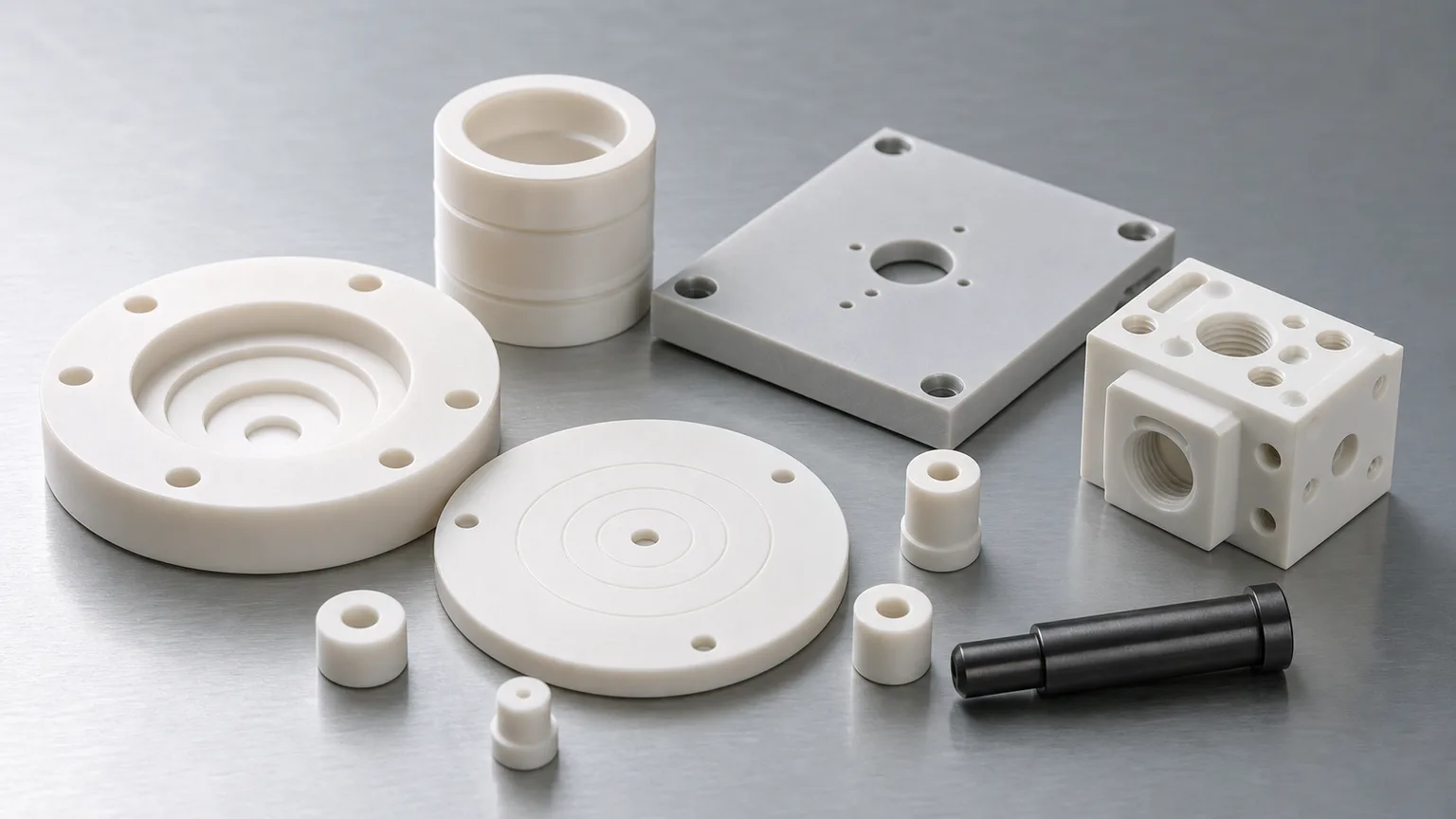
Use the RFQ page to send the package. Machinable and dense ceramic plates, blocks and discs are covered under ceramic plates and discs. Feasibility, tolerances, price and timing are confirmed only after drawing and material review.
Sources And Scope
- Corning MACOR machinable glass ceramic data sheet, copy hosted by the University of Chicago PSEC group: composition, temperature limits, mechanical, thermal, electrical and chemical-resistance data, machining notes. Corning states that production lots may vary.
- Accuratus MACOR properties: fluorine evolution in vacuum above 600 °C.
- Tokuyama, machinable AlN ceramics SHAPAL Hi M-soft: material description and machinability mechanism.
- PGO, SHAPAL Hi M-soft specifications and Ishihara Chemical machinable and engineering ceramics table: distributor typical values, stated as not guaranteed.
- Accuratus boron nitride properties: grades BO, CA and XP, offered by the supplier for comparison only.
- Accuratus aluminum oxide properties: 99.5% alumina typical values.
- Kyocera, fine ceramics production process: shaping before firing, shrinkage during sintering, diamond cutting after sintering.
Sources were checked in November 2026. All values are third-party typical data for the named grades and conditions. They are not CERAMIC CNC test results and not guaranteed part properties.
- Machinable ceramics
- MACOR machinable glass ceramic
- Aluminum nitride
- BN ceramics
- Ceramic prototypes
- Material selection