Fixture plates and locating pins
Alumina plates, zirconia pins, nests, supports, and tool interfaces controlled by datums, bore position, contact height, edge quality, and repeatability evidence.
Automation, optics, vacuum, and instruments
Organize repeatability, optical references, analytical fluid paths, high-vacuum interfaces, sensor, clean assembly, and small-batch prototype requirements into a measurable ceramic RFQ.
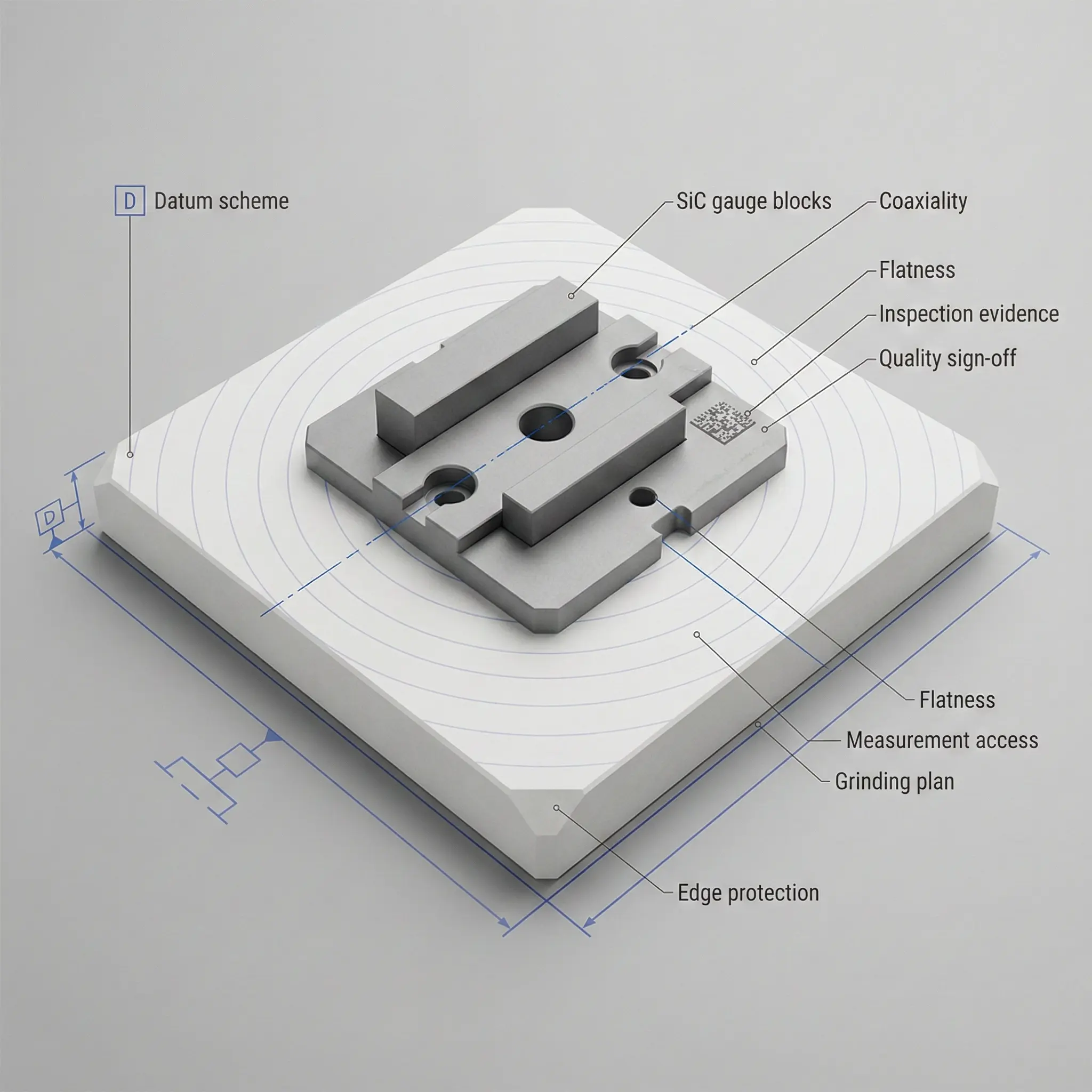
Application review
Automation, optical, vacuum, and instrument ceramic parts are often low-volume but highly interface-driven. A fixture plate may control repeatable location; an optical mount may connect a mechanical datum to an optical axis; an analytical flow cell may combine a small sample path with cleaning and blockage controls; a high-vacuum alumina component may combine sealing, trapped-volume, bake, and packaging requirements; a Macor prototype may validate geometry before a production ceramic is selected.
The machining review should start from the functional coordinate system. Datums, locating features, contact pads, bores, sealing faces, sensor axes, and protected edges need a clear relationship to the assembly. Precision without an inspection plan is difficult to quote and difficult to accept.
This hub connects fixture, metrology, optical, analytical, sensor, high-vacuum, cleanroom, and prototype guides without treating these parts as a generic miscellaneous category.
Component families
These are not catalog promises. They are review paths for connecting geometry, material, process, and evidence to the function of the part.
Alumina plates, zirconia pins, nests, supports, and tool interfaces controlled by datums, bore position, contact height, edge quality, and repeatability evidence.
Reference plates, alignment sleeves, datum pads, spacers, and inspection nests where stable geometry and a traceable measurement method are the product.
Sleeves, diaphragms, spacers, pins, flow cells, sample-path inserts, insulating bodies, and holders controlled by bore alignment, dead-volume boundaries, clean surfaces, and assembly fit.
Alumina rings, sleeves, spacers, sealing interfaces, and feedthrough-adjacent parts where bore fit, creepage, trapped volumes, flatness, cleaning, bake context, and leak boundaries interact.
Guides, support parts, fixtures, and process-adjacent hardware reviewed for particle-sensitive edges, cleaning, material traceability, and protected packaging.
Mounts, spacers, apertures, alignment fixtures, threaded Macor supports, and laboratory parts controlled by optical references, clean handling, and low-distortion assembly.
Decision map
Use the final column as a drawing and RFQ check. A requirement is easier to review when its function and acceptance evidence are stated together.
| Requirement | Why it changes the route | What to define in the RFQ |
|---|---|---|
| Functional coordinate system | Bore position, locating pins, contact pads, and sensor axes only make sense relative to stable, inspectable datums. | Identify primary, secondary, and tertiary datums plus the features that set assembly location or repeatability. |
| Contact and mounting conditions | Point loads, press fits, fastener preload, unsupported spans, and thermal mismatch can crack otherwise acceptable ceramic geometry. | Provide mating materials, support areas, clamping or torque context, fit intent, and allowed edge relief. |
| Fluid-path, vacuum, and cleanliness boundary | Small passages, sealing faces, surface condition, trapped volumes, residue, and packaging can control analytical, vacuum, or clean assembly performance. | Mark sample or gas paths, sealing surfaces, leak boundary, cleaning or bake context, particle requirement, bagging, and functional test scope. |
| Inspection and repeat orders | Prototype acceptance should establish the measurement and packaging method that future lots can repeat. | Define CMM, optical, flatness, profile, Ra, key-dimension report, first-article, and lot documentation needs. |
Material paths
Common for stable fixtures, insulation, analytical flow hardware, high-vacuum rings and spacers, sensor bodies, and clean components. Grade, purity, blank state, and finished interfaces need definition.
Useful for locating pins, plungers, sleeves, and small mechanical interfaces where toughness, wear, and finish matter.
Reviewed for stiff, wear-resistant, thermally cycled, or clean handling components. Material-specific grinding and blank risks should be addressed early.
Fit rapid prototypes, laboratory fixtures, insulating mounts, threaded features, and low-volume instrument hardware within grade-specific service limits.
Quote-ready package
Engineering guides
Each guide below narrows one part family or manufacturing constraint and leads back to the drawing information needed for review.
Specify ceramic locating pins, precision bores, datum faces, fits, edge criteria, inspection evidence, and protected packaging for repeatable manufacturing fixtures.
Select and specify ceramic mounts, spacers, alignment fixtures, apertures, insulating supports, and thermal interfaces for optical and laser equipment RFQs.
Design and RFQ guide for ceramic components used in sensors and measurement devices, including alumina diaphragms, zirconia sleeves, AlN spacers, Si3N4 pins, micro-flow cells, insulation, cleaning, and inspection evidence.
RFQ guide for ceramic needles, plungers, valve parts, flow cells, and micro-nozzles where carryover, dead volume, media, sealing, cleaning, and inspection must be defined.
Engineering guide for precision machined ceramic feedthrough insulators used in vacuum, high-voltage, semiconductor, laboratory, and electrical systems, including alumina sleeves, bore fit, sealing lands, creepage paths, cleaning, packaging, and RFQ review.
RFQ guide for dense machined alumina rings, sleeves, supports, standoffs, liners, and isolator bodies, covering trapped volumes, cleaning, joining interfaces, packaging, and leak-test ownership.
Engineering RFQ guide for precision ceramic components used in cleanroom and high-purity manufacturing systems, covering alumina, zirconia, SiC, AlN, nozzles, sleeves, spacers, rings, plates, cleaning, packaging, inspection evidence, and qualification boundaries.
How to prepare an RFQ for thin-wall ceramic sleeves, bushings, insulating tubes, precision bores, wall-thickness control, roundness, concentricity, and inspection.
How to prepare an RFQ for ceramic vacuum chucks, porous ceramic chucks, suction plates, wafer support surfaces, flatness maps, hole fields, grooves, and inspection.
How engineers should use Macor machinable glass ceramic for prototype ceramic parts, lab fixtures, insulators, vacuum components, and design validation before moving to production ceramics.
Illustrative RFQ guide for alumina inspection fixtures used around SiC power-module assembly: datum pads, locating bores, insulation, thermal contact, edge quality, and inspection evidence.
Map ceramic machining tolerances to functional features, datums, finishing access, and inspection evidence before comparing quotations or approving a drawing.
Specify ceramic surface finish by functional face, distinguish roughness from flatness and subsurface damage, and agree measurement and qualification evidence before quotation.
Questions before quotation
A quote-ready fixture package identifies the material, datums, locating features, contact pads, mating parts, loads, critical dimensions, edge criteria, quantity, inspection method, and packaging needed to preserve the reference geometry.
Macor can support rapid conventional machining, threaded features, laboratory fixtures, and geometry validation in suitable environments. It should not be assumed to match alumina, SiC, Si3N4, or AlN service performance.
Keep the material grade, blank route, datum scheme, machining and finishing assumptions, inspection method, drawing revision, cleaning, and packaging stable. Record approved changes instead of relying on nominal CAD alone.
Include material or operating environment, quantity, target timing, functional surfaces, tolerance and finish priorities, cleaning, packaging, and inspection evidence. Feasibility, price, and lead time are confirmed after review.