Plain and stepped shafts
Motor, pump, and spindle shafts with shoulders, grooves, and flats ground on functional diameters.
Product family
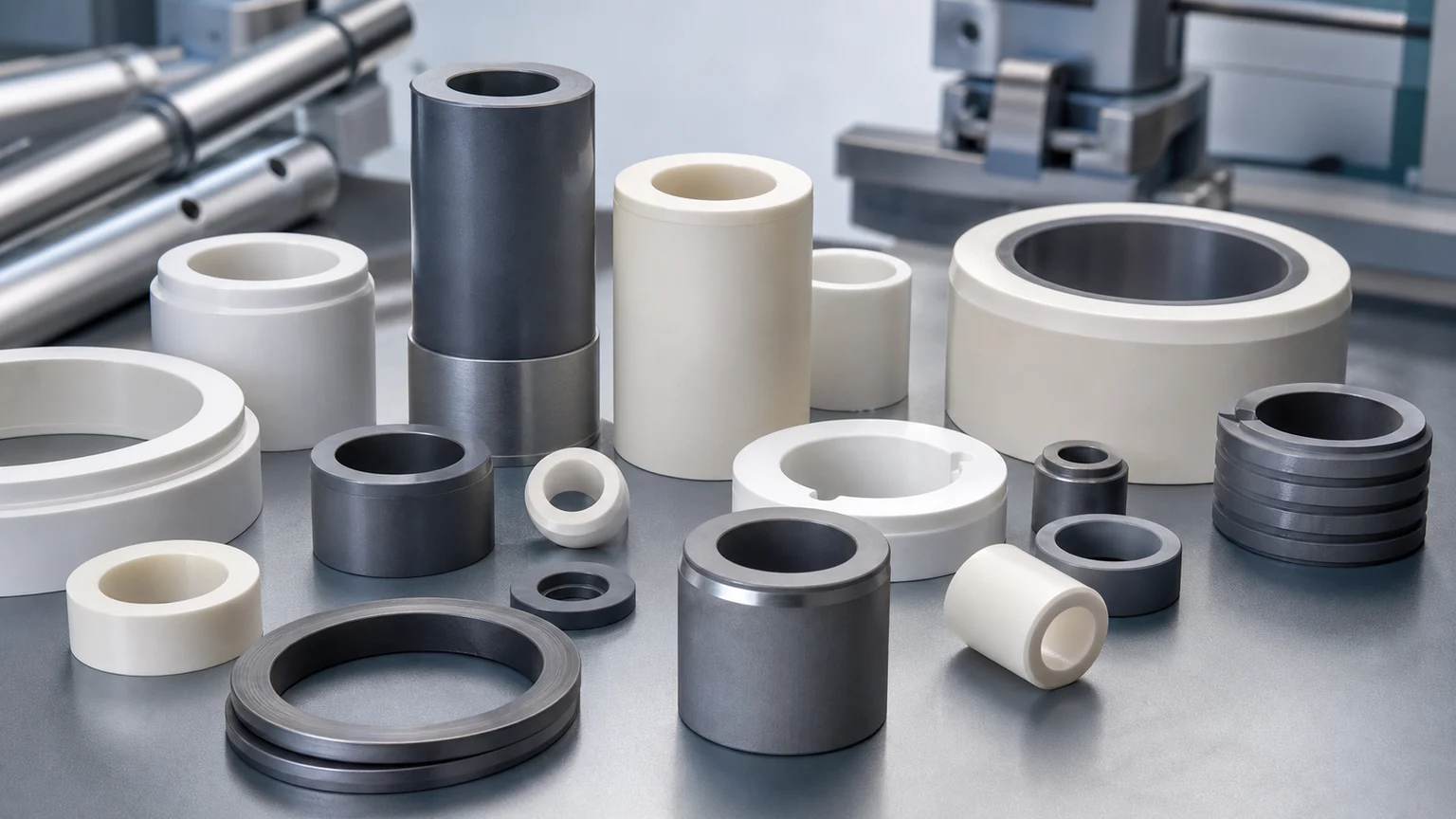
Precision ground ceramic rods, shafts, sleeves, and bushings in zirconia, alumina, ZTA, and silicon nitride for pumps, motors, textile machines, and wear guides.
Product overview
Ceramic rods and shafts are used where a metal shaft corrodes, wears, conducts, or contaminates the process. Sleeves and bushings pair with them as bearing and wear surfaces in water, chemicals, slurry, or dry running.
Typical requests include solid zirconia and alumina rods, stepped motor and pump shafts, submersible pump shafts and sleeves, hex-ground and slotted rods, threaded rods (for example for graphite-boat assemblies in solar cell processing), textile yarn guides and rollers, ceramic bearing sleeves, and shaft-and-sleeve pairs. Rods are formed by pressing or isostatic pressing, sintered, then centerless or cylindrically ground.
For long parts, straightness and the length-to-diameter ratio drive cost. For sleeves and bushings, bore finish and wall thickness matter most. Send the drawing with the running surfaces and fits marked.
Product types
These are made to customer drawings or samples, not sold from stock. Final material, route, and acceptance are confirmed for each drawing.
Motor, pump, and spindle shafts with shoulders, grooves, and flats ground on functional diameters.
Solid round rods plus hex-ground, slotted, and threaded rods; thread form and slot width are reviewed per drawing.
Bearing sleeves, shaft sleeves, and wear bushings with honed bores and controlled wall thickness.
Shafts, sleeves, and thrust parts that run in the pumped water or fluid instead of oil.
Polished guide rods, rollers, and eyelets where yarn or wire runs across the surface.
Matched running pairs with a defined clearance, supplied together and labelled as sets.
Decision map
Use the final column as a drawing and RFQ check. A requirement is easier to review when its function and acceptance evidence are stated together.
| Requirement | Why it changes the route | What to define in the RFQ |
|---|---|---|
| Straightness and length-to-diameter ratio | Long slender rods bow in sintering and need more grinding stock or straightening routes. | Give length, diameter, straightness, and whether centre holes or extra length are allowed. |
| Fits and running diameters | Bearing and seal diameters need tighter roundness and finish than clearance diameters. | Mark running and fit diameters separately and state roundness, runout, and Ra for each. |
| Threads, slots, and hex flats | Threads and slots in ceramic are ground, not cut, and their roots are chip-prone. | Specify thread form and size, slot width and depth, and acceptable root radius and chips. |
| Sleeve bore and wall thickness | Thin walls crack during grinding or press fitting; bore finish controls bearing behaviour. | Give bore and OD tolerances, minimum wall, concentricity, and the fitting method. |
| Assembly to metal | Press fits, shrink fits, and bonding load the ceramic differently and change the tolerances needed. | State the mating part, interference or clearance, operating temperature, and joint method. |
Material paths
Toughest common choice for shafts and rods that see bending, impact, or press fits.
Cost-effective for rods, guides, and sleeves where hardness and insulation matter and loads are moderate.
Toughened alumina for wear parts that need more toughness than alumina at lower cost than zirconia.
Light, strong, and thermal-shock resistant for high-speed shafts and hot or dry-running parts.
Quote-ready package
Engineering guides
Each guide below narrows one part family or manufacturing constraint and leads back to the drawing information needed for review.
Engineering guide for wear-resistant ceramic bushings, sleeves, and guide rings used in industrial machinery, including alumina, zirconia, silicon nitride, silicon carbide, ID/OD fit, roundness, Ra, counterface review, inspection evidence, packaging, and RFQ inputs.
How to prepare an RFQ for thin-wall ceramic sleeves, bushings, insulating tubes, precision bores, wall-thickness control, roundness, concentricity, and inspection.
How engineers should specify custom silicon nitride rollers, shafts, bearing-adjacent parts, sleeves, bushings, guides, and structural wear components.
How engineers should specify zirconia ceramic machining for high-strength pins, plungers, bushings, sleeves, valve parts, wear components, fixtures, and precision mechanisms.
Questions before quotation
Yes, external and internal threads can be ground into sintered ceramic within limits set by thread size and wall thickness. Fine internal threads are the most restrictive; send the thread specification for review.
There is no single limit. Length depends on diameter, material, straightness requirement, and grinding route. Send length, diameter, and straightness so feasibility can be checked.
Engineering RFQ
Start with the part function, material or grade if known, quantity, and the critical requirements; an early-stage brief is enough to begin. If online submission is interrupted, the form prepares the same RFQ as an email instead.
Prefer to use your own email?
RFQ email: info@szcomo.com
RFQ email prepared
Your email app should now show a message to info@szcomo.com with these details. Attach CAD or drawings and press send. If nothing opened, copy the text below into an email to info@szcomo.com.