Welding locating pins
Pins for nut, bolt, and projection welding that locate the part without conducting current.
Product family
Insulating, non-magnetic, wear-resistant ceramic pins for welding fixtures, nut feeding, automation, and test sockets, ground to diameter with controlled tip profiles.
Product overview
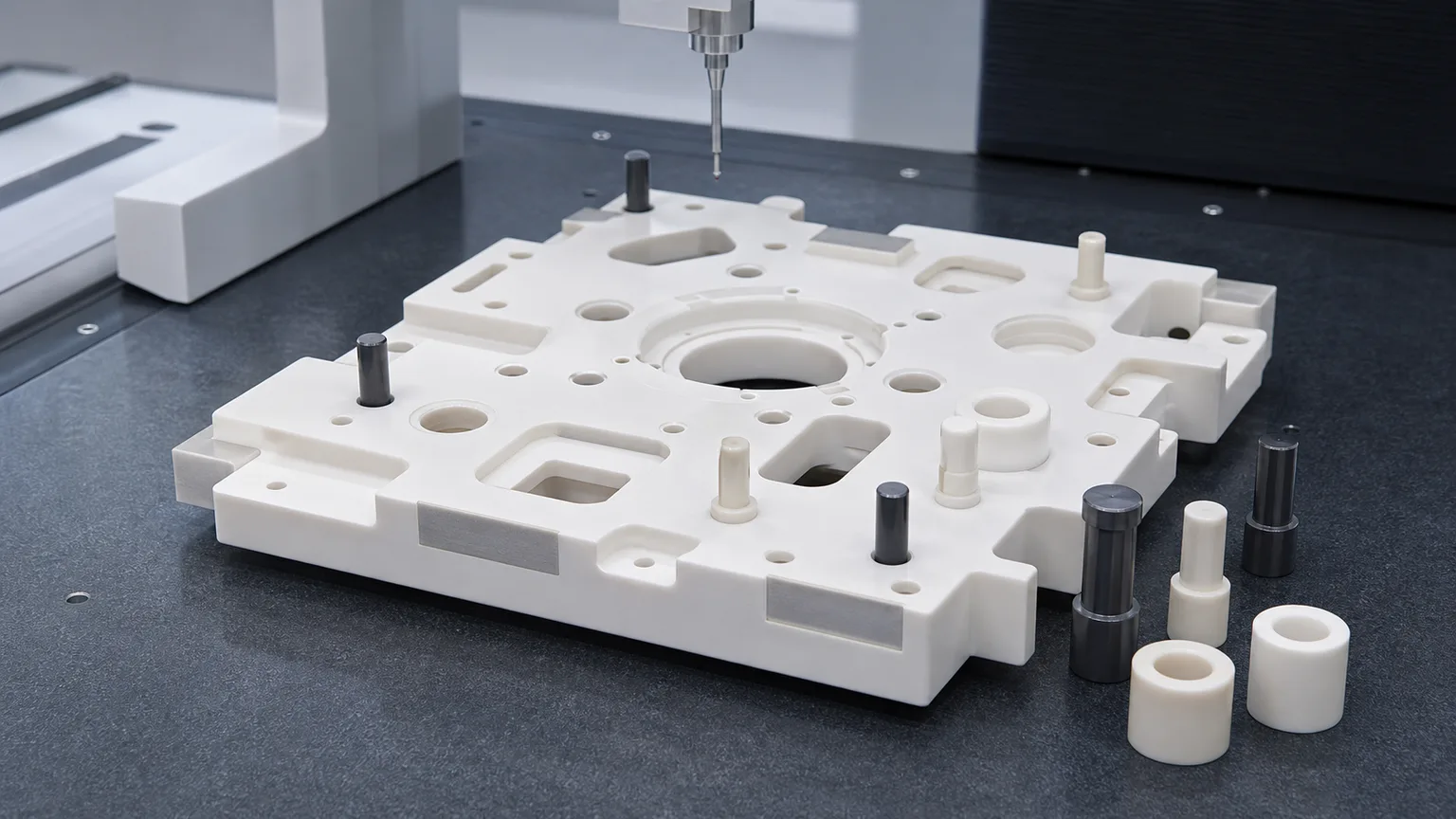
Ceramic locating pins replace steel pins where weld spatter, electrical contact, magnetism, or wear cause problems. In projection and resistance welding, a ceramic pin locates the nut or part without carrying current, and spatter does not stick to it as easily.
Typical requests include zirconia and alumina locating pins for nut and bolt welding, stepped dowel pins, guide pins for automation and test fixtures, pin needles, and ceramic pins with metal bases or threads. Pins are ground to diameter, and the tip is ground to a cone, radius, or chamfer.
Fit in the fixture, tip profile, and protection against side impact decide pin life. Send the pin drawing, the fixture fit, and the operation.
Product types
These are made to customer drawings or samples, not sold from stock. Final material, route, and acceptance are confirmed for each drawing.
Pins for nut, bolt, and projection welding that locate the part without conducting current.
Plain and stepped pins that position parts in automation and assembly fixtures.
Fine insulating pins and needles for test sockets and electronic fixtures.
Ceramic pins bonded or pressed into threaded metal bases for quick replacement.
Decision map
Use the final column as a drawing and RFQ check. A requirement is easier to review when its function and acceptance evidence are stated together.
| Requirement | Why it changes the route | What to define in the RFQ |
|---|---|---|
| Pin diameter and fixture fit | Press fits load the ceramic; clearance fits let the pin move and wear the hole. | Give pin diameter tolerance, fixture hole size, and fit type. |
| Tip profile | Cone or radius tips guide the part; sharp tips chip under side load. | Specify tip angle or radius, length, and acceptable chips. |
| Electrical and heat duty | Welding pins must insulate and survive spatter and heat cycles. | State welding type, current path, and temperature near the pin. |
| Retention method | Threads, bonding, or press fits decide how load reaches the ceramic. | Show the base or retention design and who assembles it. |
Material paths
Preferred for welding and guide pins that see side impact; tough and wear-resistant.
Higher hardness and insulation for low-impact pins and test fixtures.
Considered for hot or thermal-shock duty near welding.
Quote-ready package
Engineering guides
Each guide below narrows one part family or manufacturing constraint and leads back to the drawing information needed for review.
Specify ceramic locating pins, precision bores, datum faces, fits, edge criteria, inspection evidence, and protected packaging for repeatable manufacturing fixtures.
How engineers should specify zirconia ceramic machining for high-strength pins, plungers, bushings, sleeves, valve parts, wear components, fixtures, and precision mechanisms.
Map ceramic machining tolerances to functional features, datums, finishing access, and inspection evidence before comparing quotations or approving a drawing.
Questions before quotation
Zirconia is usually chosen because its toughness resists the side knocks pins get when parts are loaded. Alumina suits lower-impact fixtures.
Yes, ceramic-to-metal pin assemblies can be reviewed. The joint method and pull or torque test must be agreed.
Engineering RFQ
Start with the part function, material or grade if known, quantity, and the critical requirements; an early-stage brief is enough to begin. If online submission is interrupted, the form prepares the same RFQ as an email instead.
Prefer to use your own email?
RFQ email: info@szcomo.com
RFQ email prepared
Your email app should now show a message to info@szcomo.com with these details. Attach CAD or drawings and press send. If nothing opened, copy the text below into an email to info@szcomo.com.