Small complex structural parts
Parts with undercuts, cross holes, ribs, and fine detail.
Product family
Ceramic injection molding for small, complex zirconia and alumina parts at volume, combined with grinding of the features that need tighter tolerances than the molded shape gives.
Product overview
Ceramic injection molding (CIM) mixes ceramic powder with a binder, injects it into a mold, removes the binder, and sinters the part. It produces small, complex shapes such as undercuts, cross holes, thin ribs, and fine detail that would be slow or impossible to machine from a block.
Typical CIM parts include small zirconia and alumina structural parts, nozzle and valve bodies, connector and fiber-optic parts, watch and wearable parts, and blanks for plungers and pump parts. Critical diameters and faces are often ground after sintering.
CIM needs a mold, so it pays at volume. Send the 3D model, annual quantity, and which features need tighter tolerances than the as-sintered shape.
Product types
These are made to customer drawings or samples, not sold from stock. Final material, route, and acceptance are confirmed for each drawing.
Parts with undercuts, cross holes, ribs, and fine detail.
Molded bodies with internal channels finished on critical bores.
Molded blanks for plungers, pins, and tips that are ground to final size.
Small zirconia parts where appearance, colour, and polish matter.
Decision map
Use the final column as a drawing and RFQ check. A requirement is easier to review when its function and acceptance evidence are stated together.
| Requirement | Why it changes the route | What to define in the RFQ |
|---|---|---|
| Annual volume and tooling | Mold cost is paid back only at volume; prototypes may be machined instead. | Give annual quantity, prototype quantity, and tooling ownership. |
| As-sintered vs ground features | Shrinkage limits as-sintered tolerances; tight features need grinding. | Mark which features can stay as-sintered and which must be ground. |
| Wall thickness and uniformity | Uneven or thick walls cause sink, cracks, and distortion in debinding. | Send the 3D model for wall and gate review. |
| Gate and parting line marks | Gate and parting marks may need grinding on visible or functional faces. | Show cosmetic faces and where marks are acceptable. |
Material paths
Most common CIM ceramic for tough, small, polished parts.
Used for insulating and hard parts with moderate complexity.
Quote-ready package
Engineering guides
Each guide below narrows one part family or manufacturing constraint and leads back to the drawing information needed for review.
Choose a ceramic machining route by blank state, shrinkage responsibility, finishing allowance, functional datums, and first-article evidence before comparing quotations.
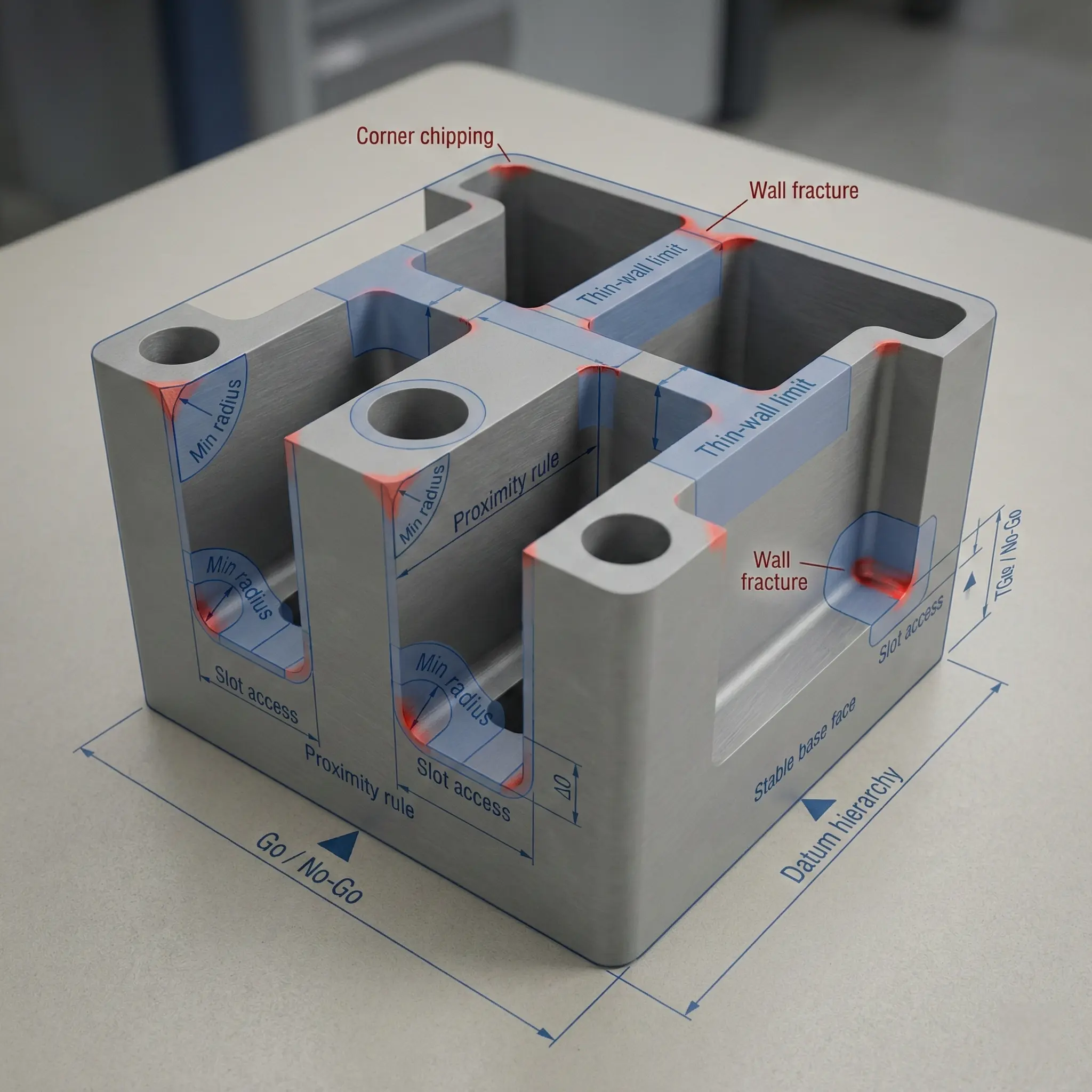
Design-for-machining rules for ceramic holes, slots, thin walls, internal radii, edge breaks, datums, and inspection access.
How engineers should specify zirconia ceramic machining for high-strength pins, plungers, bushings, sleeves, valve parts, wear components, fixtures, and precision mechanisms.
Questions before quotation
When the part is small, complex, and needed in volume. For prototypes or low volumes, machining from blanks usually costs less because no mold is needed.
As-sintered tolerances depend on size and shrinkage control. Features that need tighter tolerances are ground after sintering; mark them on the drawing.
Engineering RFQ
Start with the part function, material or grade if known, quantity, and the critical requirements; an early-stage brief is enough to begin. If online submission is interrupted, the form prepares the same RFQ as an email instead.
Prefer to use your own email?
RFQ email: info@szcomo.com
RFQ email prepared
Your email app should now show a message to info@szcomo.com with these details. Attach CAD or drawings and press send. If nothing opened, copy the text below into an email to info@szcomo.com.