Piston and cylinder sets
Matched ceramic pistons and cylinders honed and lapped as pairs; sets are kept and labelled together for assembly.
Product family
Matched zirconia, alumina, and silicon nitride piston-and-cylinder sets, rotary valve cores, and pump blanks for dosing systems where volume repeatability depends on clearance and finish.
Product overview
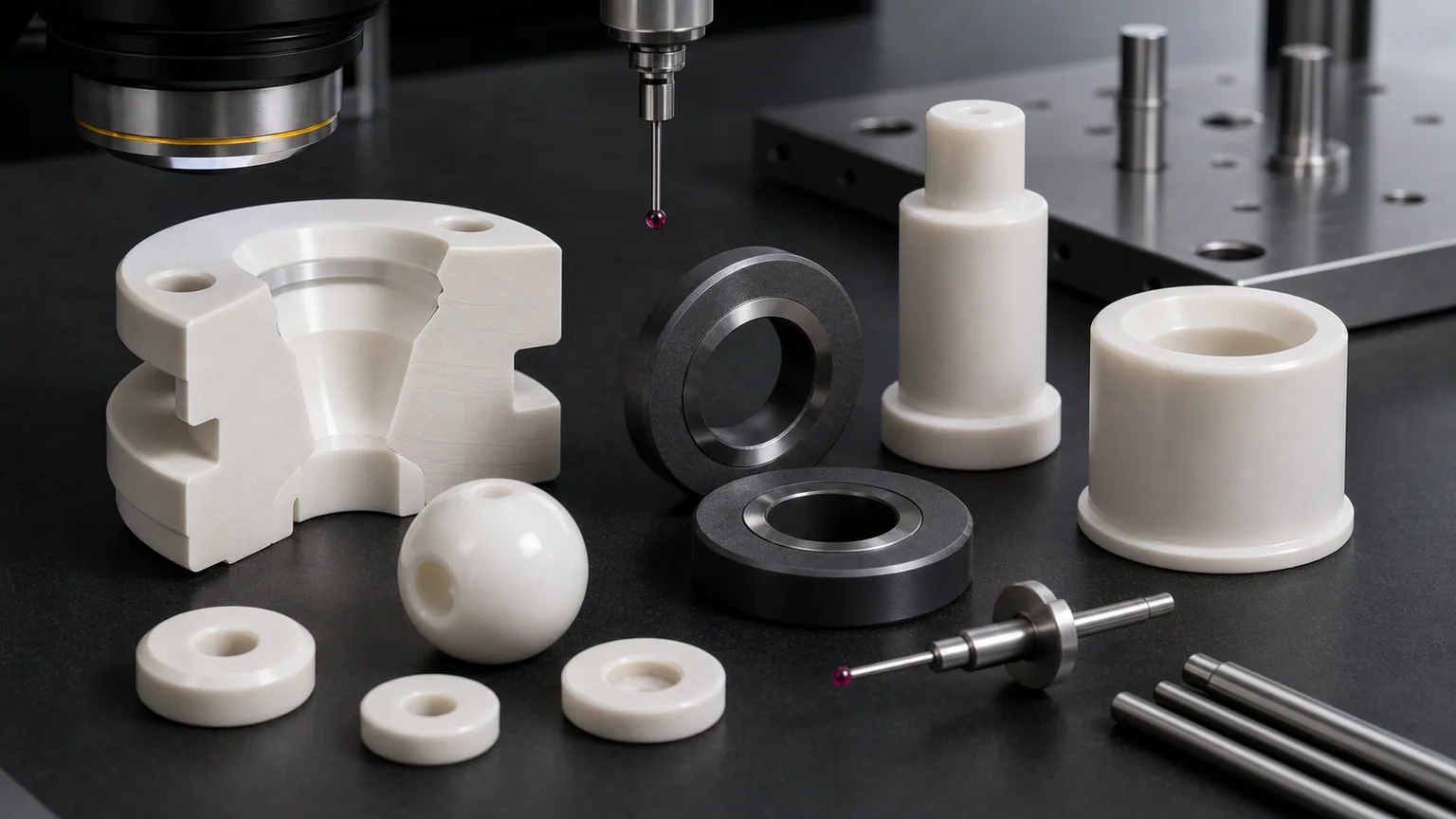
Ceramic dosing pumps meter a fixed volume per stroke with a ceramic piston running in a ceramic cylinder, often without elastomer seals. Volume repeatability depends on the piston-to-cylinder clearance, the roundness and straightness of both parts, and the finish of the running surfaces, so these parts are usually ground, honed, and matched as a set.
Typical requests include piston and cylinder sets for lithium-battery electrolyte filling machines, food and beverage filling pumps, dialysis and medical fluid pumps, laboratory metering pumps, rotary or diverter valve cores, pump stems, and pre-sintered pump blanks for customers who finish in-house.
Before quotation we need the volume per stroke, medium, cycle rate, and the clearance or leakage target. Electrolyte, food, and medical service add cleaning, contamination, and documentation requirements that must be agreed early.
Product types
These are made to customer drawings or samples, not sold from stock. Final material, route, and acceptance are confirmed for each drawing.
Matched ceramic pistons and cylinders honed and lapped as pairs; sets are kept and labelled together for assembly.
Pump cores, pistons, and valve parts for battery electrolyte filling where corrosion, particles, and dryness matter.
Filling pistons, valve cores, and nozzles where hygiene, cleaning, and food-contact records apply.
Dialysis, analyzer, and laboratory pump pistons and valve elements made from zirconia or high-purity alumina.
Ceramic rotors, valve plates, and ports that switch flow; sealing faces are lapped and port edges protected.
Sintered blanks, stems, and rods supplied with grinding allowance for customers who finish or assemble in-house.
Decision map
Use the final column as a drawing and RFQ check. A requirement is easier to review when its function and acceptance evidence are stated together.
| Requirement | Why it changes the route | What to define in the RFQ |
|---|---|---|
| Clearance between piston and cylinder | Clearance sets leakage and dosing repeatability; it is controlled by matching parts rather than by loose individual tolerances. | State the target clearance or leakage, whether sets are matched, and how sets are identified. |
| Bore roundness, straightness, and finish | The cylinder bore is honed or lapped; taper or bell-mouth changes the volume along the stroke. | Define bore size, cylindricity or roundness, straightness, Ra, and the measurement method. |
| Dose volume and stroke | Volume and stroke set the piston diameter and running length that must be precision-finished. | Give volume per stroke, stroke length, cycle rate, and acceptable volume variation. |
| Medium and contamination | Electrolyte, food, and medical fluids need grade, cleaning, and particle control decided before quotation. | Name the medium, cleaning and packaging rules, and any material or contamination declarations. |
| Ports, grooves, and valve faces | Port edges and lapped valve faces are fragile and often decide both leakage and chipping. | Mark sealing faces, flatness, port edge condition, and permitted chips on the drawing. |
| Assembly and test responsibility | A pump set may pass dimensional checks yet fail a volume or leak test in the machine. | Agree whether parts are supplied loose, as matched sets, or assembled, and who runs functional tests. |
Material paths
Tough, fine-finishing material often used for the moving piston; check compatibility with the medium and temperature.
High-purity alumina offers hardness and chemical stability for cylinders, valve plates, and ports.
Used in some electrolyte and chemical dosing pumps where its wear and chemical behaviour suit the medium; grade data is project-specific.
Piston and cylinder may use the same or different ceramics; the pairing affects wear, galling risk, and thermal clearance change.
Quote-ready package
Engineering guides
Each guide below narrows one part family or manufacturing constraint and leads back to the drawing information needed for review.
Design and RFQ guide for ceramic pump and valve components used in corrosive, abrasive, high-purity, and vacuum fluid systems, including SiC seal faces, zirconia balls, alumina seats, plungers, sleeves, lapping, and inspection.
RFQ guide for ceramic needles, plungers, valve parts, flow cells, and micro-nozzles where carryover, dead volume, media, sealing, cleaning, and inspection must be defined.
How to prepare an RFQ for thin-wall ceramic sleeves, bushings, insulating tubes, precision bores, wall-thickness control, roundness, concentricity, and inspection.
RFQ guide for lapped ceramic seal faces, valve seats, vacuum interfaces, gasket lands, flatness, Ra, edge condition, subsurface damage, and leak-test expectations.
Questions before quotation
Many ceramic piston pumps rely on a small, controlled clearance instead of elastomer seals. That only works when the piston and cylinder are finished and matched together, so the clearance target must be part of the RFQ.
Yes, replacement parts can be reviewed from drawings or samples. Send the pump model, dose volume, and medium; dimensions, material, and fit are confirmed before quotation.
Electrolyte filling pumps can be reviewed. Material choice, cleaning, drying, and packaging must match the electrolyte and plant requirements and are agreed per project.
Engineering RFQ
Start with the part function, material or grade if known, quantity, and the critical requirements; an early-stage brief is enough to begin. If online submission is interrupted, the form prepares the same RFQ as an email instead.
Prefer to use your own email?
RFQ email: info@szcomo.com
RFQ email prepared
Your email app should now show a message to info@szcomo.com with these details. Attach CAD or drawings and press send. If nothing opened, copy the text below into an email to info@szcomo.com.