Cermet blades and wear parts
Cutting blades and wear inserts that need edge retention and some toughness.
Product family
Cermet blades and wear parts, and assemblies that join zirconia or alumina parts to metal by press fit, shrink fit, bonding, or pinning.
Product overview
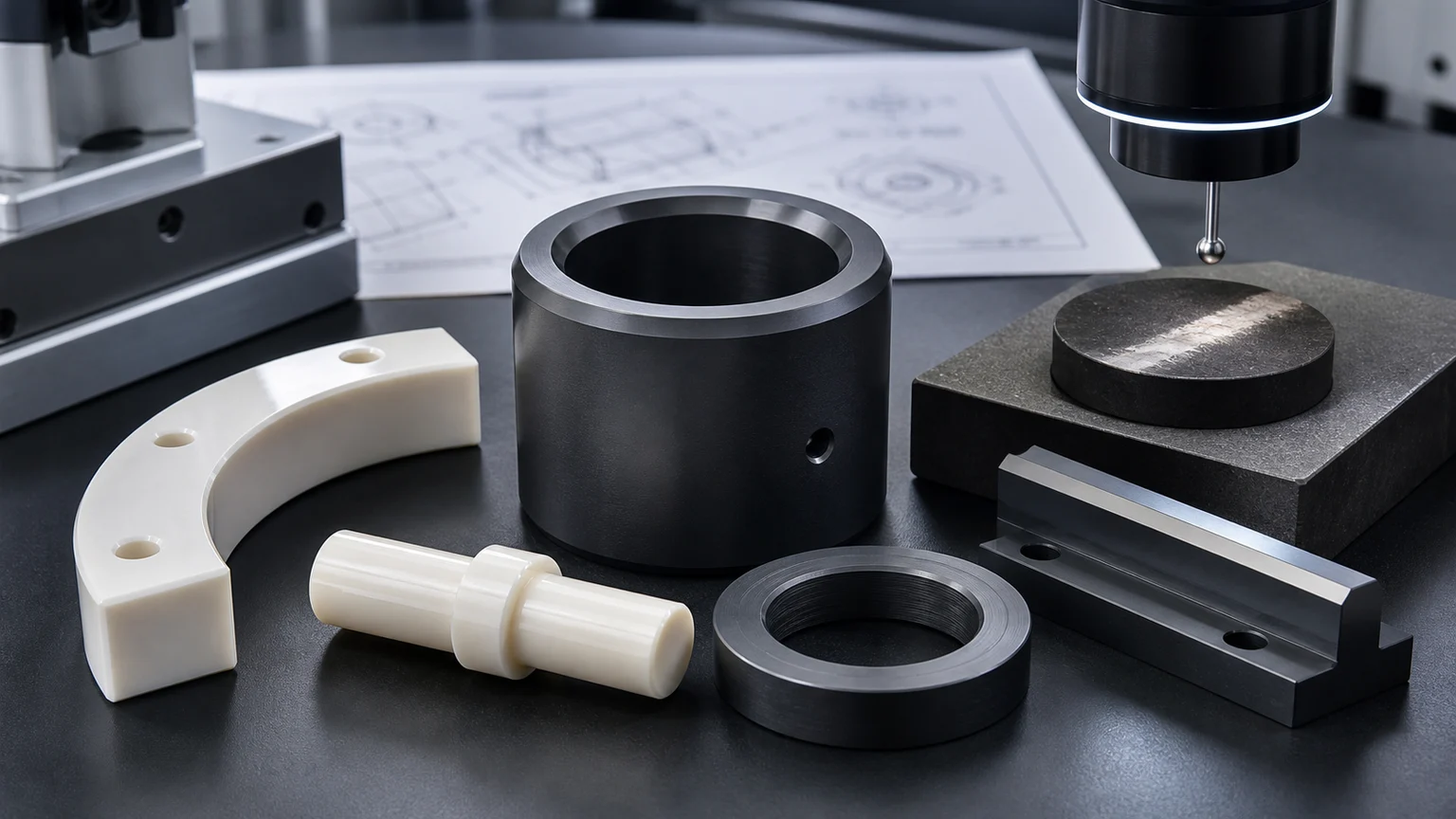
Cermets combine ceramic hard phases with a metal binder, giving wear resistance with more toughness than plain ceramic. Metal–ceramic assemblies go the other way: they place a ceramic part only where wear, corrosion, or insulation is needed and use metal for threads, mounting, and load.
Typical requests include cermet cutting blades and wear parts, ceramic sleeves in metal housings, ceramic pump cores and valve parts in metal bodies, ceramic tips on metal shafts, and pinned or bonded inserts. The joint is usually the limiting part of the design.
Send the assembly drawing, load and temperature, and who is responsible for assembly and testing.
Product types
These are made to customer drawings or samples, not sold from stock. Final material, route, and acceptance are confirmed for each drawing.
Cutting blades and wear inserts that need edge retention and some toughness.
Ceramic sleeves and liners pressed or shrink-fitted into metal housings.
Ceramic pump cores, seats, and plungers fixed in metal bodies.
Ceramic tips and pads bonded or pinned to metal holders.
Decision map
Use the final column as a drawing and RFQ check. A requirement is easier to review when its function and acceptance evidence are stated together.
| Requirement | Why it changes the route | What to define in the RFQ |
|---|---|---|
| Joint method | Press, shrink, bond, and pin joints load the ceramic differently. | State the joint method or ask for a recommendation. |
| Thermal expansion mismatch | Metal expands more than ceramic; temperature changes can loosen or crack joints. | Give operating and cleaning temperature range. |
| Load and test | The joint must carry pressure, torque, or pull without slipping. | Define load, required test (pull, torque, leak), and who performs it. |
Material paths
Grade chosen for hardness and toughness balance; confirm per application.
Zirconia expansion is closer to steel than alumina, which helps shrink fits.
Used where insulation or chemistry matters; joints need more care.
Quote-ready package
Engineering guides
Each guide below narrows one part family or manufacturing constraint and leads back to the drawing information needed for review.
Engineering guide to industrial ceramic machining for wear-resistant components, including material choice, geometry, surface finish, edge quality, inspection, and RFQ inputs.
Design and RFQ guide for ceramic pump and valve components used in corrosive, abrasive, high-purity, and vacuum fluid systems, including SiC seal faces, zirconia balls, alumina seats, plungers, sleeves, lapping, and inspection.
Engineering guide for wear-resistant ceramic bushings, sleeves, and guide rings used in industrial machinery, including alumina, zirconia, silicon nitride, silicon carbide, ID/OD fit, roundness, Ra, counterface review, inspection evidence, packaging, and RFQ inputs.
Questions before quotation
Assemblies can be reviewed. The joint method, assembly test, and responsibility are agreed in the quotation.
Engineering RFQ
Start with the part function, material or grade if known, quantity, and the critical requirements; an early-stage brief is enough to begin. If online submission is interrupted, the form prepares the same RFQ as an email instead.
Prefer to use your own email?
RFQ email: info@szcomo.com
RFQ email prepared
Your email app should now show a message to info@szcomo.com with these details. Attach CAD or drawings and press send. If nothing opened, copy the text below into an email to info@szcomo.com.