SMT pickup nozzle tips
Ceramic tips for pick-and-place nozzles, alone or inserted into metal bodies.
Product family
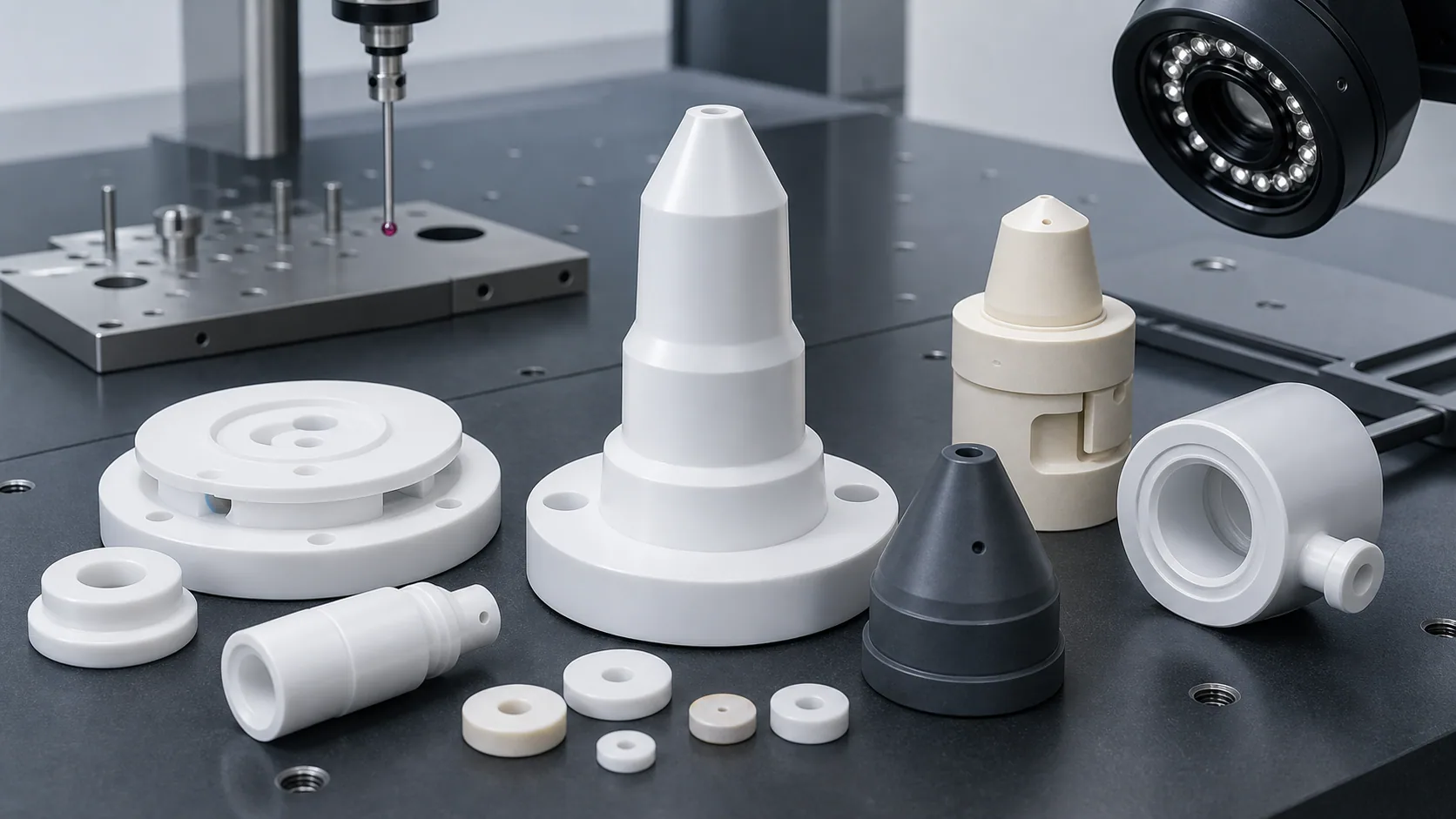
Small zirconia and alumina vacuum nozzles and pickup tips for pick-and-place, die bonding, LED sorting, and automation, where the tip face, orifice, and concentricity decide pick reliability.
Product overview
Ceramic suction nozzles hold chips, LEDs, lenses, and small components by vacuum during placement, bonding, and sorting. Compared with steel or plastic tips, zirconia and alumina tips resist wear, do not mark parts, and can be made non-conductive.
Typical requests include SMT pickup nozzle tips, die-bonder and LED sorter nozzles, multi-hole vacuum tips, nozzles with stepped or shaped tip faces, and ceramic inserts pressed into metal nozzle bodies. These parts are small, so injection molding is often used at volume, followed by grinding of the tip face and bore.
Pick reliability depends on the tip face flatness, the orifice size and edge, and the alignment between tip and shank. Send the nozzle drawing or sample and the part being picked.
Product types
These are made to customer drawings or samples, not sold from stock. Final material, route, and acceptance are confirmed for each drawing.
Ceramic tips for pick-and-place nozzles, alone or inserted into metal bodies.
Nozzles with small tip faces sized to the die or LED package being handled.
Tips with several vacuum holes, grooves, or shaped faces that match the part outline.
Flat ceramic pads and cups with vacuum channels for lenses, glass, and wafer pieces.
Decision map
Use the final column as a drawing and RFQ check. A requirement is easier to review when its function and acceptance evidence are stated together.
| Requirement | Why it changes the route | What to define in the RFQ |
|---|---|---|
| Tip face and flatness | Uneven or chipped tip faces leak vacuum and tilt the part during pickup. | Define tip face size, flatness, finish, and permitted edge chips. |
| Orifice size and edge | Orifice size sets holding force; a rough edge can mark or misplace small parts. | Specify orifice diameter, depth, and edge condition at the tip. |
| Tip-to-shank alignment | Runout between tip and shank shifts the placement position. | Give the datum on the shank and the runout or concentricity of the tip. |
| Conductivity and ESD | Some parts need insulating tips, others need static dissipation. | State whether the tip must be insulating or ESD-safe and how it is verified. |
Material paths
Tough and fine-finishing; common for small tips that see repeated contact.
Hard and insulating; used for larger pads and less impact-loaded tips.
Used where camera contrast matters; grade and colour must be agreed.
Quote-ready package
Engineering guides
Each guide below narrows one part family or manufacturing constraint and leads back to the drawing information needed for review.
Design and RFQ guide for ceramic nozzles used in semiconductor, vacuum, dispensing, gas flow, and clean equipment, including material selection, micro-bore geometry, edge quality, cleaning, and inspection.
How to prepare an RFQ for precision ceramic micro-hole machining, micro-drilling, gas distribution plates, vacuum chucks, nozzles, orifice plates, and inspection evidence.
Map ceramic machining tolerances to functional features, datums, finishing access, and inspection evidence before comparing quotations or approving a drawing.
Questions before quotation
Yes. Send the nozzle or its drawing. We confirm the tip face, orifice, and fit to the nozzle body before production.
Ceramic tips resist wear, do not mark parts, and can be insulating. Zirconia is usually chosen for small tips because it chips less than alumina.
Engineering RFQ
Start with the part function, material or grade if known, quantity, and the critical requirements; an early-stage brief is enough to begin. If online submission is interrupted, the form prepares the same RFQ as an email instead.
Prefer to use your own email?
RFQ email: info@szcomo.com
RFQ email prepared
Your email app should now show a message to info@szcomo.com with these details. Attach CAD or drawings and press send. If nothing opened, copy the text below into an email to info@szcomo.com.