Valve stems and strikers
Zirconia stems and strikers whose tip geometry and finish define shut-off and dot repeatability.
Product family
Wear-resistant ceramic stems, strikers, seats, sleeves, and nozzles for piston, jet, and needle dispensing valves that handle abrasive or filled adhesives, silicones, and pastes.
Product overview
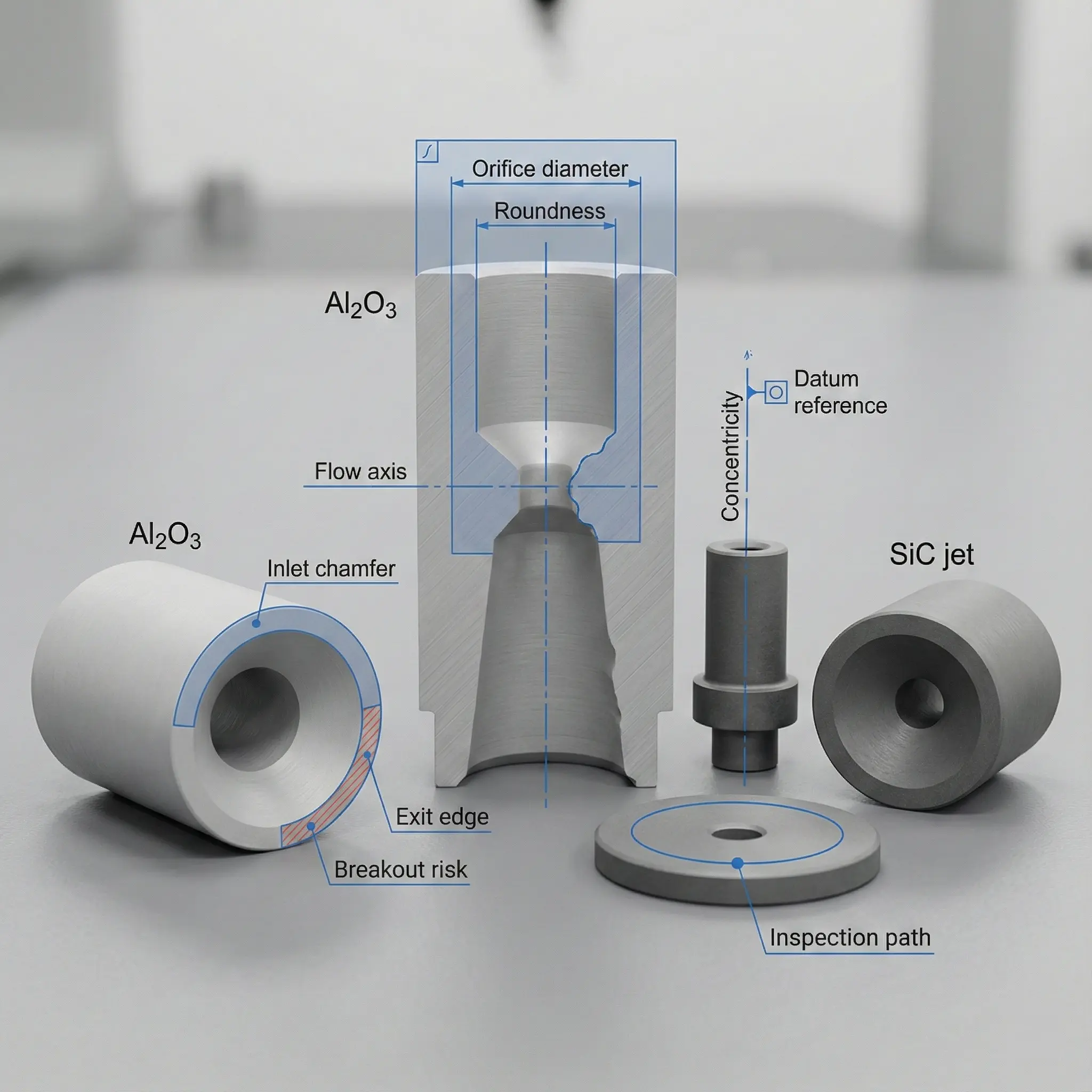
Dispensing valves wear quickly when they meter filled adhesives, phosphor silicones, solder pastes, or thermal compounds. Ceramic stems, strikers, seats, and nozzles resist that abrasion and keep the dot or line size stable for longer than steel parts.
Typical requests include zirconia valve stems and strikers for jet and piston valves, ceramic seats and sleeves, multi-hole LED dispensing heads, needle and nozzle tips, and replacement parts copied from existing valves. Many of these are small parts with micro-holes, sharp seat edges, and tight concentricity between the stem and the seat.
Because dispensing accuracy depends on the seat contact and the outlet geometry, the review focuses on the seat line, orifice size, stem-to-seat concentricity, and edge condition. Send the valve drawing or samples and the dispensed material.
Product types
These are made to customer drawings or samples, not sold from stock. Final material, route, and acceptance are confirmed for each drawing.
Zirconia stems and strikers whose tip geometry and finish define shut-off and dot repeatability.
Ceramic seats, guide sleeves, and bushings that keep the stem aligned and seal against it.
Small-orifice ceramic nozzles and tips where orifice size, roundness, and exit edge control the dispensed volume.
Multi-outlet ceramic heads where hole-to-hole position and equal flow matter.
Ceramic pistons and cylinders for piston-type dispensing valves with matched running clearance.
Copies of worn stems, seats, and nozzles reviewed from samples, with the functional surfaces confirmed before production.
Decision map
Use the final column as a drawing and RFQ check. A requirement is easier to review when its function and acceptance evidence are stated together.
| Requirement | Why it changes the route | What to define in the RFQ |
|---|---|---|
| Seat contact and stem tip | The contact line between stem and seat decides shut-off and dot size; it is a lapped, fragile edge. | Show seat angle, contact diameter, tip radius, and permitted chips at the contact zone. |
| Orifice size and exit edge | Small orifices control volume; breakout or burrs at the exit change the dot shape. | Specify orifice diameter, length, roundness, exit edge condition, and how it is measured. |
| Concentricity of stem, seat, and sleeve | Misalignment causes uneven wear, side leakage, and drifting dispense volume. | Define the datum axis and concentricity or runout for each mating part. |
| Dispensed material | Filler type and hardness drive wear rate and therefore material choice and finish. | Name the adhesive, silicone, or paste, its filler, temperature, and cycle rate. |
| Multi-hole position | Equal flow from several outlets depends on hole position and size consistency. | Give hole pattern, position tolerance, and whether flow testing is required. |
Material paths
The usual choice for stems, strikers, and small tips because toughness reduces tip chipping under impact.
Used for seats, sleeves, and nozzles where hardness and chemical stability matter more than impact.
Stem and seat materials may differ; the pairing changes wear and should be decided with the dispensed material.
Quote-ready package
Engineering guides
Each guide below narrows one part family or manufacturing constraint and leads back to the drawing information needed for review.
How to prepare an RFQ for precision ceramic micro-hole machining, micro-drilling, gas distribution plates, vacuum chucks, nozzles, orifice plates, and inspection evidence.
Design and RFQ guide for ceramic nozzles used in semiconductor, vacuum, dispensing, gas flow, and clean equipment, including material selection, micro-bore geometry, edge quality, cleaning, and inspection.
Prepare ceramic valve seats, balls, and trim for quotation: define chemical and slurry duty, mating geometry, component inspection, and assembled-valve acceptance.
Map ceramic machining tolerances to functional features, datums, finishing access, and inspection evidence before comparing quotations or approving a drawing.
Questions before quotation
Yes. Send the valve drawing or samples. We review the functional surfaces and confirm dimensions with you; brand compatibility is your responsibility to verify in the valve.
Zirconia combines wear resistance with higher toughness than alumina, which helps small tips and strikers survive repeated impact against the seat.
Engineering RFQ
Start with the part function, material or grade if known, quantity, and the critical requirements; an early-stage brief is enough to begin. If online submission is interrupted, the form prepares the same RFQ as an email instead.
Prefer to use your own email?
RFQ email: info@szcomo.com
RFQ email prepared
Your email app should now show a message to info@szcomo.com with these details. Attach CAD or drawings and press send. If nothing opened, copy the text below into an email to info@szcomo.com.